Republican Defeat Reshapes the Balance of Power Inside and Outside the United States

The results of the U.S. midterm elections, held on November 3, were not merely a temporary electoral setback for the Republican Party or a political blow to President Donald Trump halfway through his second term. Rather, they marked a significant shift in the balance of power within the United States, with control of both chambers of Congress passing to the Democratic Party. The outcome carries implications that extend beyond the American political landscape, raising questions about the future of the economic, trade, financial and foreign policies of the world’s largest economy.
Two years after Trump’s return to the White House under the slogan of restoring American power, reducing inflation and protecting domestic industry, Republicans found themselves facing a protest vote reflecting the extent of public discontent over the rising cost of living, fuel prices and the repercussions of the war with Iran, as well as growing controversy surrounding tariffs and the economic policies of the U.S. administration. According to voter polling data reported by Reuters, nearly nine out of every ten voters considered the cost of living an important or decisive factor in their electoral choices.
The result is particularly significant because Democrats did not merely regain control of the House of Representatives; they also managed to secure a majority in the Senate, making gains in states that had been considered Republican strongholds for decades, including Texas, Kansas and South Carolina. This shift marks the beginning of a new phase of institutional division in Washington, as the White House will have to deal with a Congress controlled by the opposition at a time when the economic and geopolitical challenges facing the United States are intensifying.
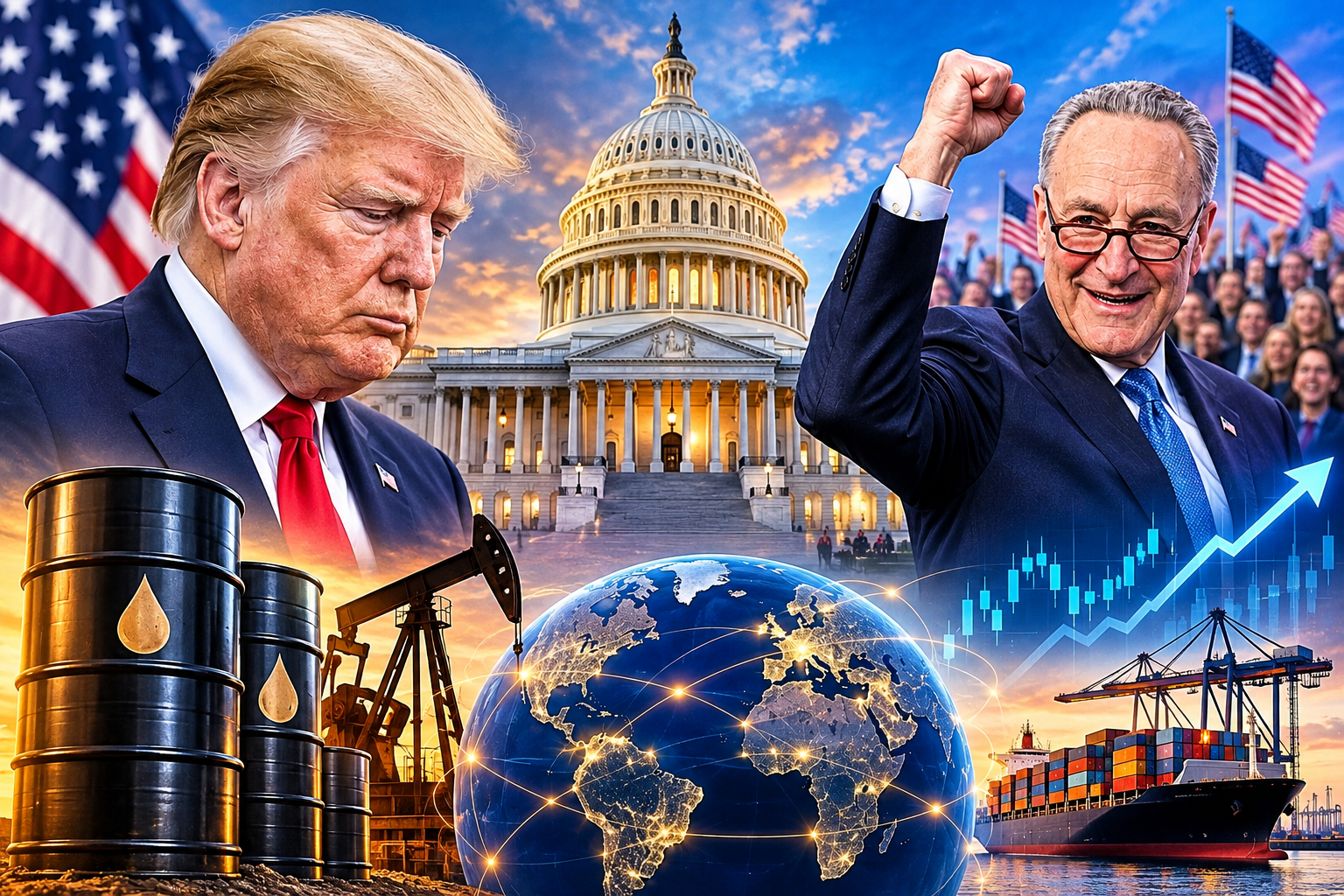
While Senate Democratic Leader Chuck Schumer described the results as a popular mandate to confront what he called “Trump’s chaos at home and abroad,” the U.S. president played down the significance of the defeat. In remarks to Fox News, he said he did not consider the elections a personal defeat, placing the blame for the failure to achieve the expected results on Republican candidates.
Between these two conflicting interpretations of the results, the most important question for the global economy emerges: Will this defeat lead to a reassessment of U.S. policies that have triggered trade, financial and geopolitical tensions, or will it push the Trump administration towards an even tougher stance in an attempt to regain the political initiative before the end of its term?
Washington Faces a New Economic Equation… Will Trump’s Agenda Be Stalled?
The transfer of the congressional majority to Democrats places the U.S. administration before a new political and economic test, given that Congress’s role is not limited to approving legislation. It also holds significant powers over budget-setting, public spending, taxation, trade legislation and oversight of government institutions.
Passing major economic projects is expected to become more difficult over the next two years, particularly those relating to taxation, spending, federal subsidies, investment and infrastructure. The Democratic majority may also use the powers of congressional committees, investigations and hearings to question officials and review decisions taken by the Republican administration, including policies concerning major corporations, energy, technology and the financial sector.
An analysis by the Edelman Institute for Public Affairs and Government Policy, published on November 4, 2026, indicates that Democratic control of both chambers will expand the scope of oversight and investigations and increase uncertainty for businesses and investors. The institute also expects negotiations over the budget and government funding to become one of the main battlegrounds between Congress and the White House, with the possibility that some projects and investment decisions could be delayed.
Tariffs are at the forefront of the issues likely to face growing political and economic friction. Trump has made trade protectionism and the relocation of American industries back to the United States two of the main pillars of his economic policy, arguing that imposing tariffs on foreign imports is a means of protecting domestic production, reducing the trade deficit and creating jobs.
However, this approach has faced criticism from economists, American companies and trading partners because of its potential impact on goods prices, production costs and supply chains. Companies that depend on imported raw materials and components may bear part of the cost of these tariffs, which could gradually be passed on to consumers, at a time when purchasing power remains one of the main concerns among American households.
The paradox is that the Trump administration may find itself compelled to defend an economic policy that was among its most prominent campaign promises, while the Democratic opposition seeks to make the rising cost of living a central issue in its scrutiny of government performance.
These developments do not, however, mean that Democrats will be able to transform U.S. economic policy comprehensively. The president retains extensive executive and regulatory powers and can continue implementing several of his policy priorities through executive orders and administrative decisions. Moreover, the passage of major legislation remains dependent on reaching agreements within Congress.
The most likely scenario, therefore, is that the United States will enter a period of institutional confrontation, during which the pace of reform may slow and uncertainty may increase regarding the future of tax, trade and investment policies. This will require businesses and markets to prepare for potentially divergent changes in Washington’s policy direction.
Energy Markets and International Trade… Who Will Bear the Cost of the U.S. Conflict?
The Republican defeat comes at an extremely sensitive moment for the international economy, as the repercussions of the war in the Middle East intersect with disruptions in energy markets, declining inventories and rising transportation and trade costs. This makes any shift in U.S. policy potentially consequential well beyond the country’s borders.
In this context, the World Bank warned in its Commodity Markets Outlook report, published on October 28, 2026, that energy prices are expected to rise by 32 percent during the current year. This reflects the scale of the shock affecting markets as a result of the conflict in the Middle East and disruptions to supplies.
The World Bank expects the average price of Brent crude to reach $91 per barrel in 2026, compared with $69 in 2025, before falling to approximately $79 in 2027, under its baseline scenario, which assumes that there will be no further major escalation in conflicts affecting supplies.
However, the international institution warned of a more pessimistic scenario that could push the average price of Brent to $105 per barrel in 2027 if tensions in the Middle East intensify and damage to Russian oil infrastructure persists.
Ayhan Kose, the World Bank’s Deputy Chief Economist and Director of the Prospects Group, said commodity markets were facing several major shocks simultaneously. He warned that rising energy costs and trade disruptions could worsen inflation and food insecurity while weakening economic growth, particularly in low-income countries already struggling with heavy debt burdens.
World Bank figures reveal that the crisis extends beyond hydrocarbons. Basic commodity prices are expected to rise by 23 percent in 2026, while metal prices are projected to increase by 25 percent, precious metals by 40 percent and fertilizer prices by 14 percent. These indicators highlight the close interconnection between energy, industrial, food and trade markets, where a disruption in one sector can spread to others.
As for oil production, the World Bank expects global supply to decline by 5.2 percent in 2026, marking the largest annual drop in more than four decades, excluding the period of the global recession in 2020. Consumption, meanwhile, is expected to fall by 2.5 percent, reflecting the impact of higher prices and supply shortages on consumer behavior and economic activity.
These figures place the Trump administration before a complex equation. Continued tensions with Iran and disruptions to maritime traffic through the Strait of Hormuz could push oil and fuel prices higher and increase pressure on American consumers. Conversely, a political settlement or a stable return of supplies could help ease pressure on markets.
The significance of this equation extends beyond the United States, given that Europe and Asia are among the regions most dependent on energy flows from the Middle East. Rising oil and gas prices increase the costs of production, transportation, heating and electricity, placing European industries under additional competitive pressure. Asian energy-importing economies, meanwhile, face the risk of higher import bills and narrower growth margins.
Any decline in Washington’s ability to push through its trade and economic policies would add another source of uncertainty to markets, particularly if the confrontation between the White House and Congress continues alongside geopolitical tensions.
China, Europe and Russia… Can Rival Powers Benefit from Washington’s Division?
The repercussions of the Republicans’ loss of Congress are not confined to the domestic American scene. They also extend to Washington’s relations with major economic powers, foremost among them China, the European Union and Russia, all of which are closely monitoring potential changes in U.S. policy during the remaining two years of Trump’s term.
For China, political division in Washington could create additional room for maneuver in trade and diplomacy, particularly if the U.S. administration’s ability to pass new legislation or impose long-term economic policy directions weakens. This does not necessarily mean, however, that U.S.-Chinese competition will diminish, since disagreements over technology, semiconductors, strategic minerals and trade enjoy political support that extends beyond the divisions between the two parties.
Tariffs remain one of the most prominent points of contention, given that any new escalation in trade tensions could affect international trade flows, supply chains and manufacturing costs, not only between Washington and Beijing but also in countries economically connected to both the American and Chinese markets.
The European Union, meanwhile, finds itself facing an opportunity to reassess its economic and trade relations with the United States amid concerns over the continuation of American protectionism and tensions surrounding defense spending, energy and industrial policies. Political division in the United States could encourage European capitals to strengthen their economic and strategic autonomy and diversify their trade partnerships and energy sources, rather than relying excessively on the policy priorities of an American administration whose agenda may change with every electoral cycle.
Russia, for its part, is not outside these calculations, particularly since any change in U.S. policy towards the war in Ukraine, economic sanctions and energy could affect Moscow’s interests and its relations with Europe. The Russian leadership may seek to capitalize on American divisions to strengthen its negotiating position, particularly if the U.S. administration encounters domestic difficulties in securing the political and financial support required for its foreign policy choices.
However, assessing the implications of the elections for U.S. foreign policy requires distinguishing between the powers of Congress and those of the president. In an analysis published on November 5, Reuters explained that Trump would retain considerable room for maneuver on international issues, ranging from Iran and Israel to Ukraine and China, despite Democrats taking control of Congress.
In this context, Reuters quoted William Wechsler, a former official and researcher with the Middle East programs at the Atlantic Council, as saying that a Democratic Congress could obstruct parts of Trump’s domestic legislative agenda but would not have an equivalent ability to prevent the president from exercising his powers as commander-in-chief of the armed forces.
The agency also quoted White House spokesperson Anna Kelly as affirming that the president had restored American strength on the international stage and that his foreign policy decisions were not driven by electoral considerations. This position reflects the administration’s commitment to maintaining continuity in its policy direction despite the Republican defeat.
By contrast, Iran specialist Sina Toossi warned that military escalation offers no clear path to victory and could deepen the very economic grievances that prompted voters to punish the Republicans.
Thus, the transfer of the congressional majority does not necessarily mean an immediate shift in U.S. foreign policy. It could, however, increase the cost of military and economic decisions and make the administration more vulnerable to scrutiny and political pressure, particularly on issues requiring funding, legislation or congressional approval.
From Washington to the Maghreb… Repercussions That Extend Beyond Oil Markets
For the countries of the Maghreb, the results of the U.S. elections cannot be treated as a political development detached from regional economic considerations. Any change in American trade, energy and financial policies could have direct or indirect repercussions for the region’s economies.
Tunisia appears to be among the countries most sensitive to fluctuations in energy prices, given its continuing energy deficit and its reliance on imports to cover a significant share of its needs. Higher oil and gas prices increase the import bill and place additional pressure on the trade balance and public finances. They may also affect transportation and production costs, as well as the prices of goods and services.
Likewise, any disruption to international trade or increase in shipping and insurance costs could affect Tunisian companies connected to external markets, whether through higher raw material costs, difficulties accessing certain markets or declining external demand.
At the same time, international economic transformations present opportunities that Tunisia could benefit from, particularly in renewable energy, export-oriented industries and digital services, provided that it succeeds in improving its investment climate, developing infrastructure and strengthening its ability to attract companies seeking alternative production locations closer to European markets.
Algeria, meanwhile, is becoming increasingly important in the equation of European energy security, given its position as a major producer and exporter of natural gas. This gives it economic and strategic leverage at a time when European countries are seeking to diversify their sources of supply and reduce risks associated with disrupted maritime routes.
As for Libya, stabilizing oil production and developing infrastructure could provide an opportunity to strengthen exports and benefit from European demand for geographically closer energy sources. However, this remains dependent on overcoming domestic challenges and ensuring the continuity of production and investment.
At the regional level, ongoing transformations may prompt a reassessment of economic partnerships between the Maghreb countries, the United States, Europe and China, particularly in the sectors of energy, minerals, infrastructure and technology. They also highlight the importance of developing Maghreb cooperation in electricity and gas interconnection and investing in clean energy, thereby reducing the vulnerability of regional economies to external shocks.
Will the Rules of the Global Economy Change, or Is Washington Entering a Phase of Political Paralysis?
The congressional election results reveal that the American economy has become a decisive factor in shaping the balance of political power, and that rising living, energy and trade costs are no longer merely domestic issues. They have become factors influencing the administration’s ability to retain its majority and political influence.
However, the Republican defeat does not necessarily mean the end of the policies pursued by the Trump administration. Likewise, Democratic control of both chambers does not, by itself, guarantee a review of tariffs, sanctions or American strategic choices. The president retains extensive executive powers, while Congress possesses legislative, oversight and financial tools that could make the implementation of certain policies more difficult.
Between the possibilities of limited compromise and political escalation, global markets appear to be entering a period of uncertainty and anticipation. Investors and businesses are concerned not only with which party controls Congress, but also with the degree of stability in the economic, tax and trade rules that shape investment, production and employment decisions.
Perhaps the most significant outcome of these elections is that Washington will enter a more complicated phase in managing its economic and foreign policy affairs, at a time when the global economy needs greater stability and coordination to confront shocks related to energy, food, trade and debt.
While Democrats are counting on turning their electoral victory into effective oversight of the Trump administration, Republicans remain committed to defending the president’s choices and rejecting what they regard as attempts to derail his agenda. Meanwhile, international powers are watching closely to see whether this division will lead to a reassessment of American policies or to further domestic confrontation that could reverberate throughout the global economy.
Thus, the “earthquake” of the congressional elections is not limited to redistributing seats within the American legislature. It opens a new phase of the power struggle between the White House and Congress and raises a question that extends beyond the borders of the United States: Can the world’s largest economy maintain the stability of its policies and its leadership of the international economy amid institutional divisions and mounting domestic and external pressures?