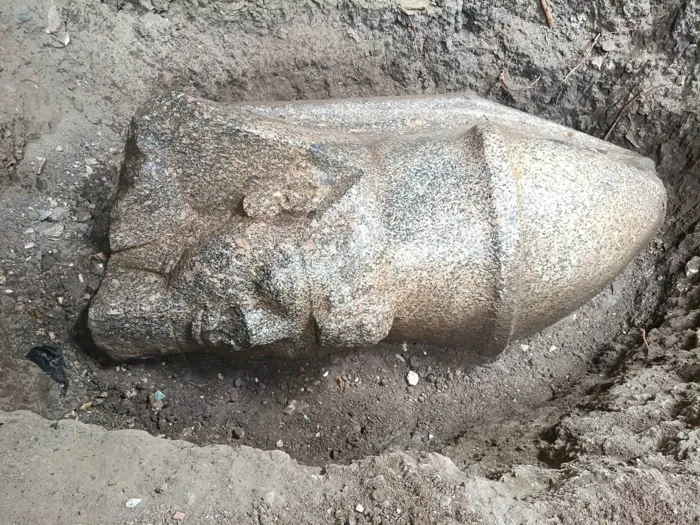
An Egyptian archaeological mission affiliated with the Supreme Council of Antiquities has uncovered the remains of two monumental royal statues during rescue excavations in the village of Bahbit el-Higara, in Egypt’s Gharbia Governorate, north of Cairo.
According to Egypt’s Ministry of Tourism and Antiquities, one of the statues depicts Pharaoh Ramesses II, while researchers believe the second may also represent the same ruler. The team additionally discovered a block of pink granite bearing hieroglyphic inscriptions that include several of the king’s royal titles.
Egyptian Tourism and Antiquities Minister Sherif Fathy said the discovery adds to the country’s growing archaeological record and offers an opportunity to learn more about the history and cultural significance of the Bahbit el-Higara area.
He also emphasized the ministry’s continued commitment to archaeological research and excavation across Egypt, alongside efforts to safeguard and preserve the nation’s historical heritage.
Details of the Archaeological Findings
Dr. Hisham el-Leithy, secretary-general of the Supreme Council of Antiquities, explained that the first find is a monumental head of Ramesses II measuring approximately 1.60 meters in height. The pharaoh is depicted wearing the double crown, which symbolizes the unification of Upper and Lower Egypt.
Excavators also uncovered the upper remains of the statue’s back pillar, which bears an inscription featuring the king’s Horus name: “Hor Ka Nakht Meri Maat.”
The size of the head suggests that the complete statue, including its base, may originally have stood approximately 8.5 meters tall. This estimated height highlights the monument’s impressive scale and artistic significance.
The second discovery consists of most of another royal statue, measuring around 2.40 meters in length. Its legs and base are missing, and experts believe it may also depict Ramesses II. The figure wears the traditional royal headcloth known as the “nemes,” although part of its upper section is damaged or missing.
The head of the second statue was also recovered. Its facial features remain clearly visible and are in relatively good condition, with noticeable similarities to those of the first statue.
Pink Granite Block Reveals Royal Titles
The archaeological team also found a pink granite block measuring approximately 1.30 meters long, located about one meter north of the second statue. The block preserves fragments of hieroglyphic inscriptions containing two titles associated with Ramesses II: “Nesw-Bity,” meaning King of Upper and Lower Egypt, and “Sa-Ra,” meaning Son of Ra.
The secretary-general of the Supreme Council of Antiquities confirmed that excavation work and archaeological studies are continuing at the site. Researchers aim to uncover additional remains, examine the newly discovered objects and establish how they relate to one another and to the surrounding archaeological landscape.
The ongoing investigations are expected to provide a clearer understanding of the two statues, the history of the area and its architectural development during ancient Egyptian civilization.
Bahbit el-Higara, located in the Nile Delta within Gharbia Governorate, is considered an important archaeological site. It is known for the remains of a large temple dedicated to the goddess Isis, as well as granite blocks and architectural elements that reflect the area’s religious and architectural importance in ancient Egypt.