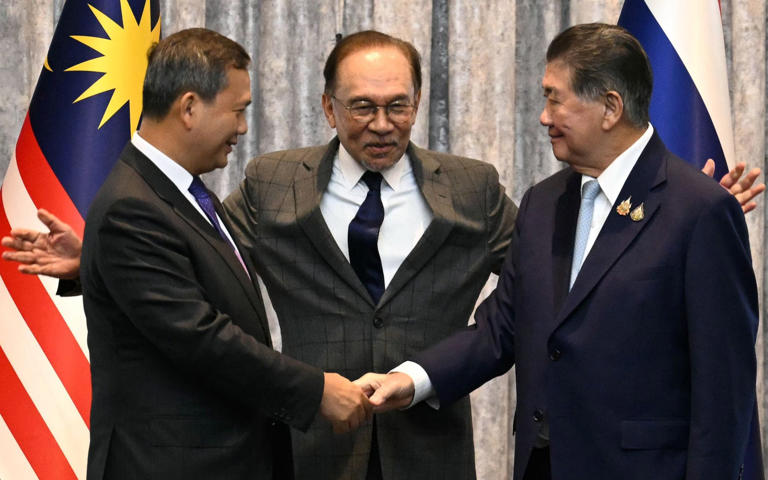
Thailand and Cambodia have thanked Donald Trump for his “decisive mediation” after agreeing to an unconditional ceasefire.
At least 35 people have been killed and over 200,000 displaced since five days of fighting between the two countries began on July 24.
The agreement comes after Donald Trump threatened to withdraw the US from critical tariff negotiations unless the two countries stopped fighting.

Both Phumtham Wechayachai, the acting prime minister of Thailand, and Hun Manet, Cambodia’s premier, thanked the US president for supporting the talks.
Mr Hun said there had been a “very good meeting” and thanked both Mr Trump and the Chinese government for their involvement in discussions.
He expressed his “deep appreciation” to Mr Trump “for decisive mediation”.
As it stands, both Thailand and Cambodia will be hit by a 36 per cent tax on imports from next month – a major economic hit that the countries are trying hard to avoid.
Malaysia hosted mediation talks, and on Monday afternoon prime minister Anwar Ibrahim said: “Both Cambodia and Thailand reached a common understanding as follows: One, an immediate and unconditional ceasefire with effect from 24 hours local time, midnight on July 28 2025, tonight.”


He added: “This is a vital first step to a de-escalation and a restoration of peace and security.”
Mr Wechayachai said his country had negotiated a ceasefire “in good faith” and that Thailand was committed to peace.
But analysts said it was not yet clear whether peace will be lasting – or if deep-rooted disputes will be resolved.
Tita Sanglee, a Bangkok-based associate fellow at the ISEAS-Yusof Ishak Institute think tank, told The Telegraph: “Tensions are still extremely high and I feel like the fighting – whether in the form of actual clashes or information warfare – will resume.
“The ceasefire is on shaky ground – ‘peace’ is very uneasy when a lot of concerns haven’t been addressed.”
Spats between the two rivals are nothing new, with much of the animosity dating back to differing interpretations of a colonial-era map. But the latest clashes have been the bloodiest in decades.
Thailand has so far reported 22 deaths, while more than 139,000 people have been evacuated from border provinces. Meanwhile in Cambodia, there have been at least 13 deaths, and 79,000 people have fled from their homes.
Tensions rose between the two nations in May, after a Cambodian soldier was killed in a skirmish on the disputed 508-mile border. But relations deteriorated after two groups of Thai soldiers were injured by landmines last Wednesday.
Soon after the incident, both sides downgraded relations, expelled their neighbour’s ambassador and recalled embassy staff.
Then, on Thursday, heightened tensions ignited into clashes. Both sides have blamed the other for starting the violence, which has seen ground troops, tanks, drones, rocket launchers and F-16 jets deployed.
The flames of war were also fanned by strongmen politicians in Bangkok and Phnom Penh, with escalating tensions mirroring the rapid decline in relations between Hun Sen and Thaksin Shinawatra, two former prime ministers whose children now hold power.
Both countries have also seen a surge in nationalistic sentiment since Thursday – which has left some feeling sceptical of whether the ceasefire will be lasting. Neither government wants to appear weak, and distrust of the other side is rampant among the public.
Ya Yinh, an NGO executive who fled Cambodia’s Oddar Meanchey province, said on Monday: “I wish this will be a positive step, but I am not optimistic that [the] Thai military will fully respect it.”
Close to the front line in Thailand’s Sisaket province, their residents said the opposite. They told The Telegraph on Sunday that they wanted peace so they could continue their lives – but did not trust the Cambodians.
In a deserted town Prasert Srithon, who usually runs a food stall in front of his house, said: “Of course we have been concerned about when the war could end … this district is usually flourishing economically, but if everything is closed how do we make a living?
“So of course we want peace, but it depends on them – not us. Their [Cambodia’s] leaders are not to be trusted, they say things and don’t do it,” he said.
The ceasefire will start at midnight local time (4pm UK), before military commanders from both countries hold an “informal meeting” first thing on Tuesday morning. There will be further talks between defence attaches next week.
The agreement will also see direct communications resume between Thailand and Cambodia’s prime ministers, foreign ministers and defence ministers. Meanwhile a “detailed mechanism” is being drawn up for the “implementation, verification and reporting of the ceasefire”, according to a press release – though it remains unclear what this will look like.