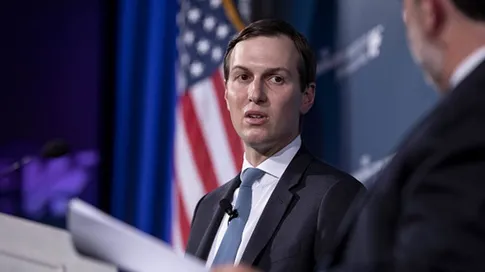
The U.S. network “CNN” revealed that the U.S. president’s son-in-law and special envoy was conducting negotiations over a ceasefire in Gaza, while supporting the war there through a private company he owns that has ties to the military activities of the “Israeli army.”
In an extensive investigation, the network said that “while Jared Kushner was playing a central role in Middle East peace negotiations, the private equity firm he owns held the largest stake in an Israeli company that supports institutions linked to Israel’s military campaign in Gaza, including Israel’s largest arms manufacturer.”
The network said Kushner avoided undergoing deeper scrutiny over this potential conflict of interest by serving as a volunteer envoy, rather than accepting a government position that would have required him to disclose his financial holdings.
In doing so, Kushner created an unprecedented dual role for himself within the Trump administration; a role combining profitable business interests with high-stakes politics amid a devastating war.
“CNN” said it traced some of the investments linked to the military side of “Phoenix Financial” – a Tel Aviv-based company in which Kushner’s investment group doubled its stake last year, shortly before Donald Trump’s return to the White House – with Kushner later describing “Phoenix” as “Affinity’s best investment.”
Those records – which cover only a small portion of “Phoenix’s” holdings – show that the company invested hundreds of millions of dollars in Israel’s largest arms manufacturer, “Elbit Systems.” “CNN” also found that “Phoenix” held stakes in at least eight other companies that provide equipment to the Israeli army, ranging from drones and warships to demolition vehicles.
All nine companies identified by the U.S. network saw their share values rise last year, with several of them stating that the war in Gaza had led to increased demand for their products and services.
Since the spring of 2025, Kushner has emerged as a leading voice for the U.S. administration in the Middle East, advising Trump and traveling around the world to negotiate with leaders – including Israeli Prime Minister Benjamin Netanyahu – and even unveiling plans to rebuild the Gaza Strip and transform it into a global tourist hub.
Kushner was a key architect of the Gaza ceasefire agreement reached through mediation between “Israel” and the Hamas movement last October; despite that agreement, “Israel” has continued to carry out strikes on the Strip on an almost daily basis.
Kushner spoke openly about his investment in “Phoenix” and his role as a peace mediator, considering financial profit to be the best way to achieve lasting peace.
Kushner said on the “No Priors” podcast in September last year: “When an Arab and an Israeli come together and start talking about a business opportunity, they forget everything else and realize that there is a lot they have in common.”
He added: “Investors coming from the Middle East are looking at Israel now and saying, ‘Wait a minute, perhaps there is a benefit to ending these wars.’”
But critics argue that Kushner’s financial entanglements – combined with his informal role as a powerful White House representative in a war-torn region – raise questions about whether he is acting in the interests of taxpayers or in his own financial interests.
Cynthia Brown, senior ethics adviser at Citizens for Responsibility and Ethics in Washington (CREW), said: “There are always people who profit from wars or government policies. But the difference is that those who profit should not themselves be the ones making decisions about those policies. And that is exactly what is happening here.”
A White House spokesperson played down concerns about a potential conflict of interest between Kushner’s roles as a volunteer and businessman, describing them as “a tired narrative that Democrats have been pushing against President Trump, his family and his administration for a decade.”