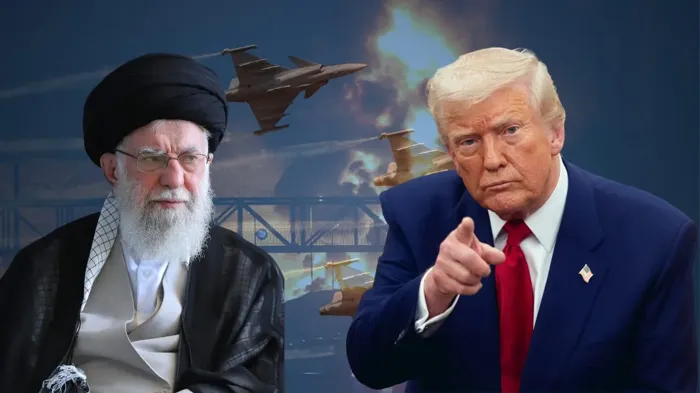
There are increasing indications that the United States is close to carrying out a military strike against Iran within days, given the failure to reach an agreement with Tehran at the last minute. Although the potential targets of any American attack seem largely predictable, the results of this move remain unpredictable, as the region could face a wide range of scenarios from the least bad to the worst possible outcomes.
Limited strikes
The British BBC network mentioned 7 possible scenarios in the event that US President Donald Trump decides to launch a military strike against Iran. The first scenario is that the US Air Force and Navy carry out precise and limited strikes targeting Iranian military sites, including bases of the Islamic Revolutionary Guard Corps and the Basij paramilitary unit under its control, in addition to ballistic missile launch and storage sites and facilities related to the Iranian nuclear program.
This scenario is based on the assumption that the attack will lead to the downfall of the regime and ultimately pave the way for Iran to become a truly democratic system, but it is a prospect described as overly optimistic, in light of past experiences of Western military interventions in several countries in the region.
Survival of the regime
The second scenario assumes that the Iranian regime will remain in place after the strike, but will be forced to adjust its policies. According to this view, however, this scenario is among the least likely, as the leadership of the Islamic Republic has maintained its position of refusing change for 47 years, and is seen as being unable or unwilling to change its political and security course.
military rule
Many believe that the third scenario is the most likely, which is the collapse of the current regime and its replacement with military rule, as the data indicates that one of the main reasons for the failure of previous protests to overthrow the regime is the absence of major defections within the ruling establishment.
If the US strikes are followed by chaos, Iran could end up under strict military rule led by prominent figures from the Iranian Revolutionary Guard, thus reproducing power in a different form.
military response
Iran has vowed to retaliate against any US attack, asserting that its forces are on high alert. Although its military capabilities do not match those of the US air and naval forces, it possesses a vast arsenal of ballistic missiles and drones, many of which are stored in caves, underground facilities, or remote mountainous areas.
American military bases and installations are spread along the Arab side of the Gulf, and Iran could, if it chose to, target vital infrastructure in countries it considers complicit in any American attack.
Strait of Hormuz
The fifth scenario is that Iran resorts to planting naval mines in the Gulf, a threat that has been raised since the Iran-Iraq War between 1980 and 1988, when Iran actually planted mines in shipping lanes, and Royal Navy minesweepers helped remove them.
The Strait of Hormuz, located between Iran and Oman, is a vital passage for global trade, through which about 20 percent of the world’s liquefied natural gas exports and between 20 and 25 percent of oil and its derivatives pass.
Iran has conducted exercises on rapidly deploying naval mines, which means that any such move would directly affect global trade and energy prices.
naval attack
In the sixth scenario, Iran might attempt to sink a U.S. warship, a possibility that worries some U.S. military leaders. This threat relies on what is known as a swarm attack, in which large numbers of high-explosive drones and fast torpedo boats are launched at one or more targets simultaneously.
The Iranian Revolutionary Guard Corps Navy has long assumed the leading role in the Gulf, with a clear focus on unconventional or asymmetric warfare, with the aim of overcoming the technological superiority of the U.S. Fifth Fleet. The sinking of a U.S. warship, with the potential capture of surviving crew members, would be a major humiliation for the United States.
endless war
The seventh and final scenario represents the collapse of the regime and the rise of chaos in its place, a possibility that raises serious concerns among neighboring countries. In addition to the risk of a civil war similar to what happened in Syria, Yemen and Libya, there are the risks of ethnic tensions turning into armed conflicts.
Groups such as the Kurds, Baloch, and other minorities may seek to protect their regions in the face of a complete power vacuum. Although many countries in the Middle East may welcome the end of the Islamic Republic’s rule, most notably Israel, which sees the Iranian nuclear program as an existential threat, no one wants to see a country with a population of about 93 million people slide into chaos.
The greatest danger remains that the US president might decide to take military action after amassing large forces near Iran’s borders, for fear of losing credibility, which could open the door to a long war with no clear end in sight and with unpredictable and possibly devastating consequences.