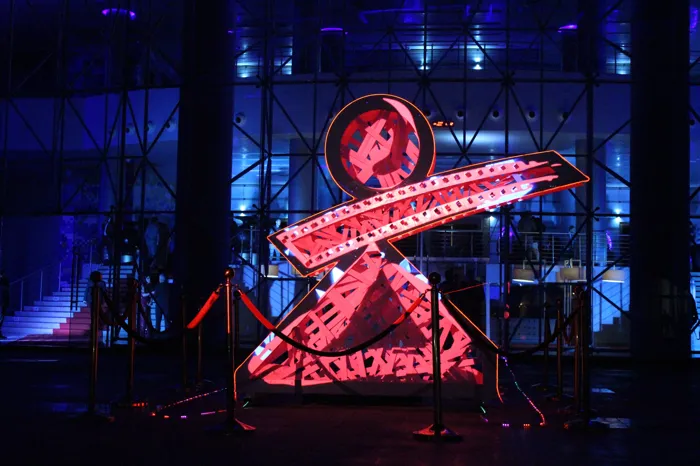
The 36th edition of the Carthage Film Festival kicked off this Saturday evening, continuing until December 20, with an official ceremony held at the Opera House in the City of Culture, amid a notable presence of filmmakers from Tunisia and various Arab and African countries, in addition to participants from Europe, Asia and Latin America.
A tribute to Ziad Rahbani
The opening ceremony featured special tribute segments, including a screening of an excerpt from the film “Nahla” by director Farouk Bloufa, in a special tribute to the late artist Ziad Rahbani, followed by a musical performance by artist Omar Al-Waer on the piano, with the participation of artist Mariam Al-Obeidi, where they performed the songs “Take Me With You, My Love” and “Without Anything” in a moment that combined music and artistic memory.
The ceremony also included the “Cinema Under the Microscope” segment, which this year was dedicated to celebrating Armenian, Filipino and Spanish cinema, as part of the festival’s openness to diverse cinematic experiences from different continents.
“Honorary Tanit”
The ceremony honored the international star of Tunisian origin, Claudia Cardinale, along with a number of prominent names in Arab, African and international cinema, including the Algerian Mohamed Lakhdar-Hamina, the Malian Souleymane Cissé, Pauline Soumano Vieira from Benin, and the Lebanese director Walid Shmeit.
The Tunisian producer Abdelaziz Ben Mlouka was also awarded the “Honorary Tanit” in recognition of his career and contributions to supporting Tunisian and Arab cinema.
“Palestine 36” opens the festival
The ceremony included the presentation of the films in the official competition and the introduction of the jury members, before the screening of the opening film “Palestine 36” by Palestinian director Annemarie Jacir, in the presence of the crew. This film is nominated to represent Palestine in the 2026 Academy Awards.
In his opening remarks, the director of the Carthage Film Festival, Tarek Ben Chaabane, welcomed the guests of the event, expressing his pride in the presence of filmmakers from around the world, and emphasizing the status of the festival as the oldest Arab-African film event that celebrates cinema, its makers, and the convergence of ideas.
Ben Chaabane explained that the uniqueness of the Carthage Film Festival lies in its constant ability to renew itself with its audience, and in its continuous defense of auteur cinema, recalling the saying of the artist Ziad Rahbani, “I love you for no reason,” to express the passion for cinema, and recalling what the international director Martin Scorsese said about the need not to let the industry “kill cinema,” before he officially announced the opening of the thirty-sixth session.
For her part, Palestinian director Annemarie Jacir expressed her pride in the selection of the film “Palestine 36” to open the festival, stressing that the work was completed during one of the most difficult periods in the history of the Palestinian people, and through the efforts of a Palestinian crew who worked for years inside Palestine.
She revealed that the Israeli occupation’s aggression against Gaza led to the destruction of what had been completed of the film more than once, and caused filming to stop four times in a row, but the determination to complete the work remained “for the sake of Palestine, which loves life and never stops hoping.”
She also expressed her gratitude to Tunisia and the Carthage Film Festival for their support and solidarity, stressing that the festival’s voices and images reach Palestine.
Palestine is present
The Palestinian issue is strongly present in this session through the screening of the documentary film “From Zero Distance” by director Rashid Masharawi, filmed during the occupation’s aggression on Gaza after October 7, 2023.
The festival opens wide windows onto diverse world cinemas, and dedicates programs to modern Arab cinema, and the “Green Cinema” section concerned with environmental issues, in addition to the “Carthage for Professionals” program, which is held from December 15 to 18, with the aim of supporting Arab and African film projects and enhancing opportunities for their production and distribution.