Cairo News – Abdullah Ali Askar
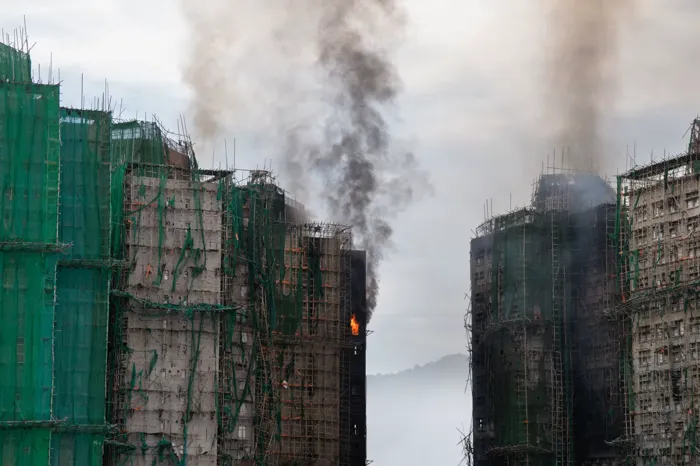
In moments, residential towers in Hong Kong were engulfed in flames, as the city experienced one of its deadliest fires in decades. As rescuers struggled to recover victims and search for the missing, questions mounted about the safety of building materials and the traditional bamboo scaffolding surrounding the renovated structures.
Victims and missing persons
The deadliest fire in Hong Kong in decades has killed at least 55 people and injured hundreds, after it spread through several residential towers within the complex, which is home to a large number of elderly people, according to Chinese media.
The residential complex was undergoing renovation and surrounded by bamboo scaffolding and safety nets at the time of the fire. Authorities announced the arrest of three men working for a construction company on suspicion of manslaughter related to the incident.
Bamboo scaffolding
“Bamboo is definitely a flammable material, and more prone to ignition in Hong Kong’s dry season, as its vertical shafts allow fire to easily spread upwards,” said Xinyan Huang, associate professor in the Department of Building Environment and Energy Engineering at Hong Kong Polytechnic University, according to CNN.
Hong Kong leader John Lee said housing authorities would examine the protective layers used to cover residential buildings during renovations to check their fire resistance, and suggested that bamboo scaffolding, which has previously been cited as a possible cause of similar fires, may have been a factor in Wednesday’s incident.
He also announced that the government would conduct a thorough inspection of all bamboo scaffolding in the city, and that the development office was discussing with the construction office the possibility of switching to metal scaffolding.
Fire spread
He added that the fire spread to a height of 32 floors in just five minutes in the “Wang Fook Court” building in Hong Kong, making it extremely difficult for residents to evacuate the building within a 20-minute deadline.
He explained that the time required to evacuate a building of this height is very slow compared to the speed at which the fire spread, adding that the fire managed to reach the top of the building in five minutes or less, while it took the residents at least ten or twenty minutes to evacuate it.
According to CNN, Huang stressed that the main question in the investigation is not about the cause of the fire but about its unusual speed of spread. He said that the building is designed to deal with random incidents, but it is not designed to contain the rapid spread of a fire that starts outside the structure and then spreads inside.
Bamboo scaffolding
The burned complex was surrounded by bamboo scaffolding, an ancient building technique dating back to the Han Dynasty and still widely used in Hong Kong. This scaffolding is hundreds of feet high and wrapped with safety nets colored green, blue, or purple.
The use of bamboo is not limited to new buildings; it is also relied upon in the renovation of thousands of historic residences annually, making it an essential part of the city’s building environment.
However, this technology is facing increasing criticism due to safety concerns, the durability of the flammable material, and its susceptibility to damage. The Hong Kong Development Authority announced that half of all new public building projects commencing after March will utilize metal scaffolding to protect workers and comply with modern standards in developed cities. This announcement sparked angry reactions from residents who consider scaffolding part of their cultural heritage that should be preserved.
Juman Ho, a structural engineer at the British company Arup, told CNN that solutions are needed to overcome the risks of bamboo, suggesting treating the columns with an epoxy or plastic solution to prevent corrosion and delay the material’s deterioration.
Hong Kong leader John Lee said the government would inspect all bamboo scaffolding in the city, adding that the development bureau was meeting with the construction bureau to discuss the switch to metal scaffolding.