
European Parliament member and president of the “Place Publique” movement Raphaël Glucksmann announced last Sunday his intention to run in the 2027 French presidential elections, in a surprising move that will undoubtedly disrupt the French political landscape, which is experiencing the growing rise of the far right, represented primarily by Marine Le Pen and her “National Rally” party, after she topped the latest opinion polls for the first round of the French presidential elections scheduled for April 18, 2027.

With Glucksmann announcing his candidacy for the upcoming presidential elections alongside Jean-Luc Mélenchon, who has also announced his candidacy for the French presidential elections for the fourth consecutive time, the French left is gaining strength in its confrontation with the far right and with the efforts of its leader, Marine Le Pen, to reach the Élysée Palace after three unsuccessful bids. Her discourse rejecting French citizens of immigrant backgrounds and different ethnic origins has found broad resonance, in addition to its explicit challenge to the principle of citizenship by birth, or what is known as jus soli.
Mélenchon, who supports the Palestinians: Will he succeed in winning voters’ support?
The prospects of veteran left-wing politician and leader of “La France Insoumise,” Jean-Luc Mélenchon, in the upcoming French presidential elections have improved relatively, according to recent opinion polls, which currently indicate that he enjoys between 16% and 17% support (Harris Interactive). He could qualify for the second round of the French presidential elections scheduled for May 2, 2027, against Le Pen, who is leading voting intentions with figures ranging between 35% and 38%.
However, his remaining in the second round of the electoral race still depends on the balance within the centrist and moderate right-wing camp, as well as on Le Pen overcoming the legal complications she is facing after recently being convicted by the courts on charges of misappropriating public funds. This could pave the way for her protégé, Jordan Bardella, to become an alternative candidate in her place should she be convicted.

Jean-Luc Mélenchon is known for his opposition to the policy of the French government, which refused to impose sanctions on Israel over its aggression against Gaza, accusing it of complicity in Israeli crimes. He has strongly attacked French officials, describing their position as “cowardice and submission,” while also criticizing their statements encouraging the continuation of the war and violations of international law. He has repeatedly warned against France becoming involved in supporting Israeli military operations aimed at killing Palestinians.
Although Mélenchon had previously pledged to step aside to make way for a younger generation, he surprised everyone by announcing his candidacy for the French presidency, confronting the “National Rally,” which he considers a danger to France, with a program that includes positions fundamentally critical of Israeli and U.S. policies in the Middle East. This is alongside his repeated calls on Paris to confront the war of extermination in Gaza, the military campaign against Iran, and Israel’s continuing violations in southern Lebanon, as well as his assessment that the wars in the Middle East have exhausted the French economy, warning of their potential economic and social repercussions for France.
Immigration and reviving the French economy: Le Pen’s priorities in the upcoming elections
In contrast, far-right leader Marine Le Pen revealed, when announcing her candidacy for the upcoming French presidential elections, her intention to make every possible effort to restore what she considers full national sovereignty over the borders in the face of migrant flows. She stated that she wanted freedom of movement within the “Schengen” area to be limited to citizens of European Union countries. She also revealed, in an interview with Le Journal du Dimanche, the slogan of her electoral campaign, “Reviving France,” and said that her electoral program focuses on the priorities of reviving French industry, reforming the healthcare system, developing education, and strengthening security.
Despite her conviction by the French Court of Appeal, Marine Le Pen denied having committed any criminal offense and said that she would continue her electoral campaign, which will be launched soon, as long as she legally retains the right to stand for election. She also stated that her party, the “National Rally,” would continue the struggle until victory, in her words.
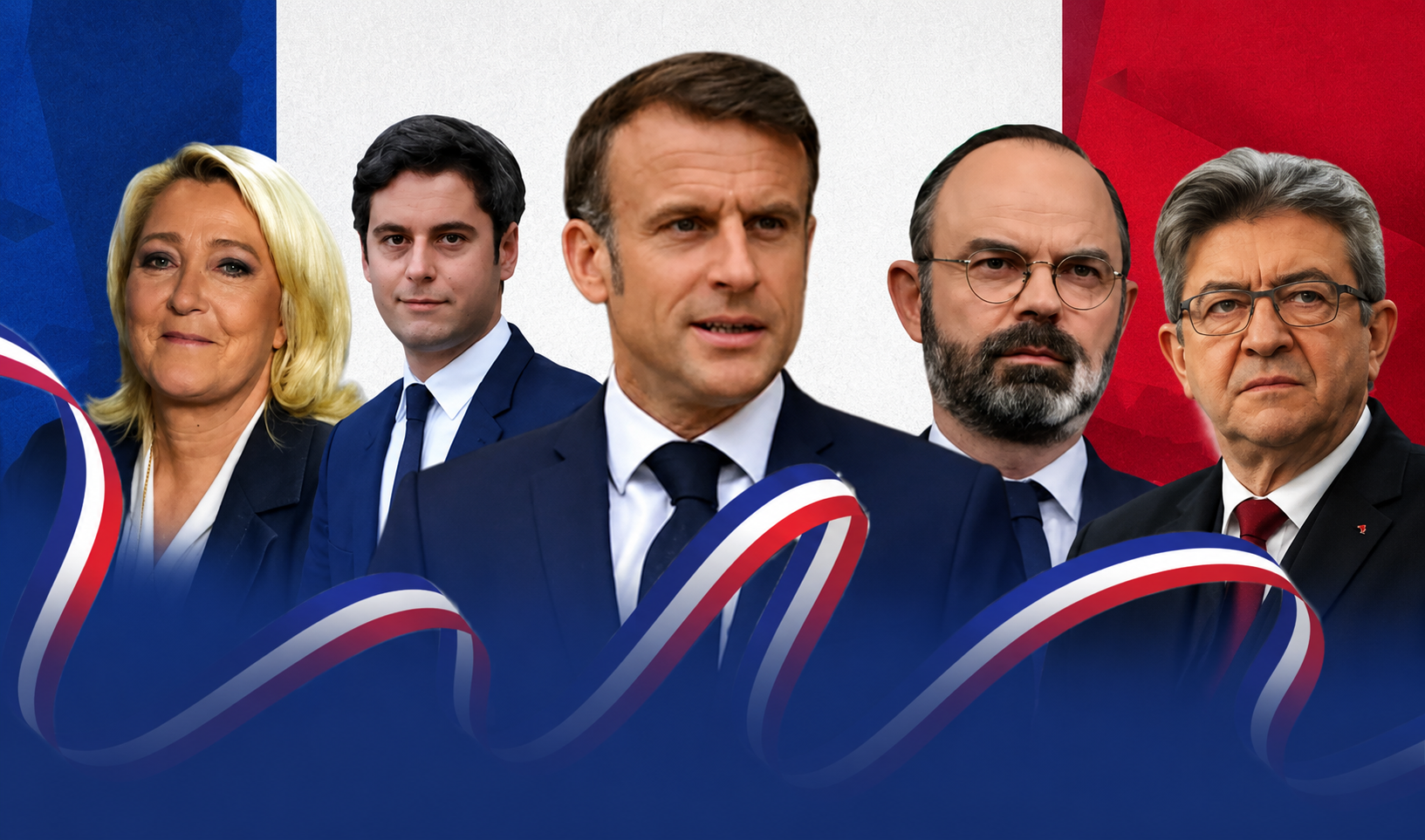
With far-right leader Le Pen topping opinion polls on voting intentions for the first round of the French presidential elections, the French left is witnessing deep divisions and intense rivalry between radical left leader Mélenchon and moderate politician Glucksmann, who is seeking to unite the center-left and bring the political family together. Meanwhile, the centrist camp is positioning former Prime Minister Édouard Philippe as its candidate in the upcoming presidential elections, following Emmanuel Macron’s departure from the race upon completing his presidential term, with the support of prominent figures such as Gérald Darmanin and Gabriel Attal.
It is certain that the Palestinian issue and the situation in the Middle East will play a central role in the 2027 French presidential elections, because the ongoing conflict in the Middle East intersects with political struggles in France, particularly anti-racist and anti-imperialist movements, as well as liberation and progressive movements.
The Palestinian issue, for example, is expected to feature prominently in the electoral campaigns of left-wing figures because of their opposition to supporting Israel, as well as their longstanding defense of civil liberties, the rule of law, and democracy, and their continued calls to break with the crimes of extermination and atrocities committed by Israel against the Palestinian people.