Tehran – africanews info
By Kamal Ben Younes
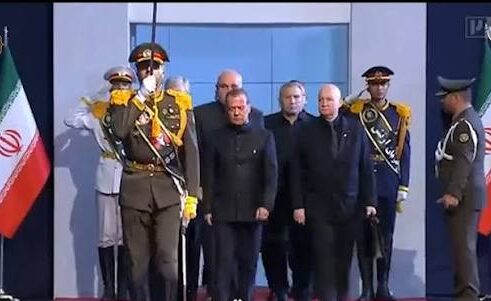
The participation of Russia, China and Turkey in the farewell ceremonies for the late Iranian leader Ali Khamenei carried significance far beyond diplomatic protocol and official condolences. All three countries were represented at a high political level during the ceremonies held in Tehran, while Moscow, Beijing and Ankara each maintain important economic, commercial and strategic relations with Iran, although the nature and priorities of those relationships differ from one country to another.
At the farewell ceremonies held in Tehran on July 3, 2026, Russia was represented by Dmitry Medvedev, Deputy Chairman of the Russian Security Council and former President of the Russian Federation; China by He Wei, Vice Chairman of the Standing Committee of the National People’s Congress; and Turkey by Cevdet Yılmaz, Vice President of the Republic, accompanied by official, diplomatic and parliamentary delegations.
The three officials were among the most prominent foreign dignitaries present in Tehran to offer condolences and take part in the farewell ceremonies.
The presence of these three states was particularly significant because of their respective positions within Iran’s network of foreign relations. Russia has become an increasingly important strategic and political partner for Tehran; China is Iran’s main economic outlet and the largest buyer of its oil; while Turkey remains a major economic and commercial neighbor, as well as an important partner in energy, transport and overland trade, despite competition and disagreements over several regional issues.
Russia: Medvedev in Tehran as Strategic Partnership Expands
Russia’s participation was one of the most notable international presences at the farewell ceremonies. Dmitry Medvedev, Deputy Chairman of the Russian Security Council and former Russian president and prime minister, traveled to Tehran at the head of the Russian delegation to attend the ceremonies and convey Moscow’s condolences.
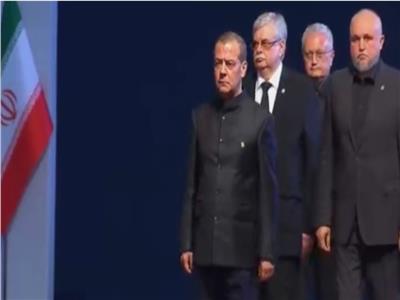
This high-level representation cannot be separated from the major transformation in relations between Moscow and Tehran in recent years.
In January 2025, Russian President Vladimir Putin and Iranian President Masoud Pezeshkian signed a 20-year Comprehensive Strategic Partnership Treaty. The agreement provides for expanded cooperation in numerous sectors, including energy, trade, transport, banking cooperation, oil and gas projects, and the peaceful use of nuclear energy.
The treaty also provides for the development of payment mechanisms and financial settlement systems aimed at reducing both countries’ dependence on third-country currencies and financial systems.
On the commercial front, trade between Russia and Iran had reached around $4.8 billion in 2024, an increase of approximately 16%. Russian officials later announced a further increase of more than 20% in bilateral trade in 2025 compared with the previous year.
Moscow and Tehran also hope to strengthen trade through the free trade agreement between Iran and the Eurasian Economic Union, which is led by Russia.
The agreement, which entered into force on May 15, 2025, provides for significant tariff reductions on the vast majority of traded goods. According to the Eurasian Economic Commission, it covers around 90% of the relevant product categories.
Transport is also a major area of Russian-Iranian cooperation.
The International North-South Transport Corridor is one of the most important strategic projects for both countries. Moscow is seeking to use Iran’s railway, road and port networks to gain access to the Persian Gulf, the Indian Ocean and Asian markets.
The Rasht-Astara railway line in northern Iran is a key link in this project. It is expected to help connect Russia with Azerbaijan and Iran, and then with commercial routes leading toward India and other Asian markets.
Medvedev’s presence at the Tehran ceremonies therefore carried particular political significance. It came at a time when relations between Russia and Iran have moved from limited cooperation on specific issues toward a much more institutionalized partnership covering the economy, energy, transport and finance, as well as political and security matters.
China: Official Representation and an Economic Partnership Driven by Energy
China was represented at the farewell ceremonies by He Wei, Vice Chairman of the Standing Committee of China’s National People’s Congress, one of the senior positions within the country’s legislative institution.
China’s Foreign Ministry had officially announced that He Wei would represent Beijing at the ceremonies held in Tehran on July 3, 2026.
China is currently Iran’s most important economic partner, particularly in the oil sector. However, assessing the full scale of economic exchanges between the two countries requires caution because of international sanctions, financial restrictions and the fact that a significant portion of energy trade does not appear in traditional customs statistics.
According to data published in the United States, official Chinese statistics recorded bilateral trade with Iran worth $9.96 billion in 2025.
However, estimates that include Iranian oil exports to China not fully reflected in those statistics put the value of such shipments at around $31.2 billion, bringing the broader estimated value of the commercial relationship to approximately $41.2 billion.
By mid-2025, shipping data indicated that China was importing around 43 million barrels of Iranian oil per month.
At that time, the Chinese market was absorbing approximately 90% of Iran’s oil exports, while Iranian crude accounted for roughly 13.6% of China’s total oil purchases.
Chinese-Iranian economic relations, however, extend beyond oil.
In March 2021, the two countries signed a 25-year strategic cooperation program aimed at expanding their partnership in energy, infrastructure, transport, investment and trade.
The relationship between Beijing and Tehran is not, however, an exclusive economic alliance.
At the same time, China maintains major trade and investment relations with other Middle Eastern countries, particularly Saudi Arabia and the United Arab Emirates.
In 2025, China’s trade with each of those two countries exceeded $100 billion, a level far higher than the estimated value of trade with Iran, even when oil exports not fully reflected in traditional customs data are included.
These figures show that Iran’s importance to China is based mainly on energy security, strategic geography and political coordination, while Beijing continues to pursue a balancing policy between Iran and its other partners in the Middle East.
In this context, the participation of a senior Chinese official in the farewell ceremonies reflects the continuity of the partnership between Beijing and Tehran.
For Iran, China represents an essential market for energy exports and a commercial partner that helps reduce the impact of sanctions. For Beijing, Iran is both an important source of energy and a strategically located country along trade routes linking Asia with the Middle East.
Turkey: Geography Imposes Cooperation Despite Political Competition
The nature of the relationship between Turkey and Iran differs from Tehran’s ties with Moscow and Beijing.
Ankara was represented at the ceremonies by Cevdet Yılmaz, Vice President of the Republic of Turkey, who traveled to Tehran at the head of a delegation including government officials, diplomats and members of parliament.
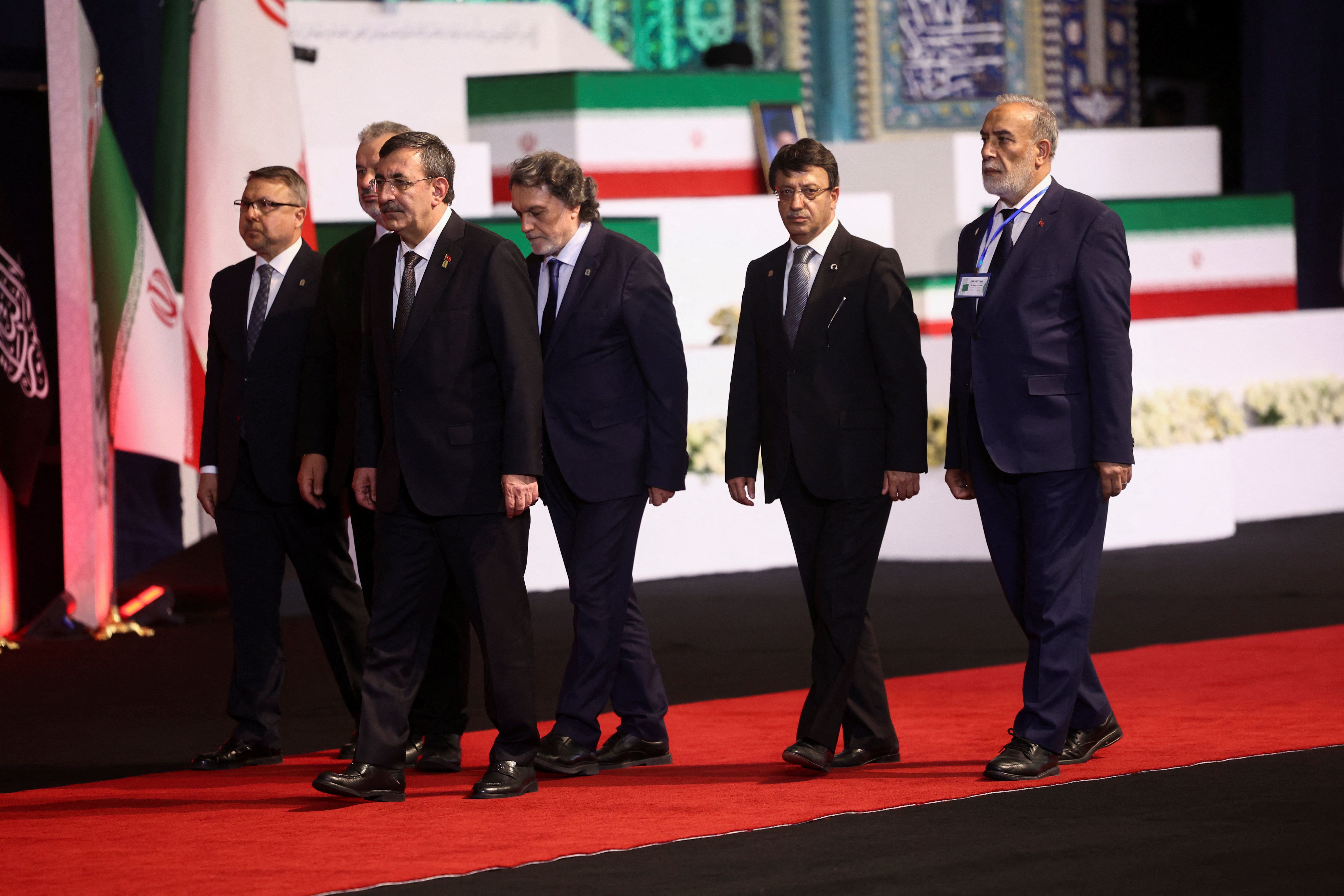
Yılmaz attended the ceremonies held at Tehran’s Mosalla complex, accompanied by officials from the Turkish Foreign Ministry, Turkey’s ambassador to Iran and members of parliament.
During his visit, the Turkish vice president reaffirmed Ankara’s desire to develop economic relations with Iran in the fields of trade, energy, transport and investment.
Turkey and Iran share a long land border, as well as important transport, trade and energy networks that allow economic relations to continue even when their political positions diverge on some regional crises.
According to available figures, Turkish exports to Iran reached $2.3 billion in 2025, while Turkish imports from Iran amounted to around $2.2 billion during the first eleven months of the same year.
Recorded trade between the two countries had therefore already exceeded $4.5 billion even before full data for the final month of the year were included.
These figures nevertheless remain well below the ambitions publicly expressed by both governments.
During an official visit to Turkey by former Iranian President Ebrahim Raisi in January 2024, the two countries reaffirmed their intention to increase bilateral trade.
Turkish officials said at the time that bilateral trade had reached around $7.4 billion in 2023, compared with a historic peak of nearly $22 billion in 2012.
Natural gas is one of the main pillars of economic relations between Ankara and Tehran.
Turkey imports Iranian gas through pipelines under a long-term contract providing for annual capacity of around 9.6 billion cubic meters.
In April 2026, Turkish Energy Minister Alparslan Bayraktar said that the contract was due to expire in July 2026. He also stated that Turkey had imported 7.6 billion cubic meters of Iranian gas during the previous year, accounting for around 13% of the country’s total natural gas imports.
Trade relations with Iran are also particularly important for Turkey’s eastern provinces, where economic activity depends heavily on border crossings, road transport, regional trade, tourism and local commerce.
Ankara and Tehran have repeatedly discussed opening additional border crossings and establishing commercial centers in border regions to increase trade and support economic development in neighboring provinces.
The Turkish-Iranian relationship nevertheless remains different from the expanding strategic partnership between Iran and Russia or Tehran’s strong dependence on the Chinese market.
It combines economic cooperation, political competition and the management of differences. The interests of the two countries converge in trade, energy, transport and border stability, while their positions may diverge on several regional issues.
Three Participants, Three Different Models of Relations with Tehran
The participation of Russia, China and Turkey in the farewell ceremonies for Ali Khamenei illustrates three distinct models within Iran’s network of international relations.
Russia is moving toward an institutionalized strategic partnership with Tehran covering trade, energy, transport, financial mechanisms and major infrastructure projects.
Moscow is placing particular emphasis on the free trade agreement with the Eurasian Economic Union and the development of the International North-South Transport Corridor.
China, for its part, is Iran’s most important partner in terms of oil exports and trade with Asia.
At the same time, Beijing is careful to preserve its extensive commercial relations with the Gulf monarchies and other major Middle Eastern economies.
Turkey, finally, maintains a relationship with Iran based largely on geographical proximity, overland trade, natural gas, transport and cross-border exchanges.
This interdependence makes economic cooperation necessary for both sides, despite political rivalry over certain regional issues.
From this perspective, the presence of Dmitry Medvedev, He Wei and Cevdet Yılmaz in Tehran was not merely a matter of protocol.
It also reflected the place Iran occupies in the strategic calculations of Moscow, Beijing and Ankara, as well as the central role that economics, energy, transport and trade are likely to continue playing in the relations of these three capitals with Tehran in the coming years
[15:48, 05/07/2026] +216 99 479 498: بالنسبة لمقال المشاركة الروسية والصينية و التركية اضافة توقيعي بالعربية والفرنسية والانقليزية
بقلم كمال بن يونس
طهران . أفريقيا نيوز انفو
Africanewsinfo
Kamel Ben Younes
[15:49, 05/07/2026] +216 99 479 498: مواكبة الحدث ولو عبر أخبار قصيرة مدعومة بالصور
[15:49, 05/07/2026] +216 99 479 498: شكراً
[15:49, 05/07/2026] Monia Ayadi: Ok
[16:09, 05/07/2026] +216 99 479 498: فيما يلي مقال إخباري تحليلي بصياغة صحفية متوازنة، يربط بين وقائع المشاركة ودلالاتها السياسية والإقليمية الراهنة: