By Sonia Ftouhi
Journalist and expert in international affairs
Negotiations between Washington and Tehran over Iran’s nuclear program are scheduled to begin the day after tomorrow, Friday, after having been ruled out on several occasions amid preparations for a potential military strike repeatedly hinted at by U.S. President Donald Trump. This move appears to be part of an effort to pressure Iran into complying with what he described as essential conditions to rule out the military option, which remains on the table at this stage.
Following a period of ambiguity surrounding the diplomatic track between the United States and the Islamic Republic of Iran particularly regarding the venue of the talks and the parties that could attend to help resolve outstanding issues it was agreed that the Sultanate of Oman would host negotiations that many observers view as Tehran’s last opportunity to avoid a military strike that could, this time, lead to the collapse of the ruling regime.
U.S. envoy Steve Witkoff is expected to meet Iranian officials this week to discuss the core issue, namely Iran’s nuclear program. However, Washington appears keen to include Iran’s long-range ballistic missile program and its support for regional allies in the Middle East on the agenda demands that Tehran rejects, insisting that the talks focus exclusively on its nuclear activities and avoid issues it considers internal affairs.
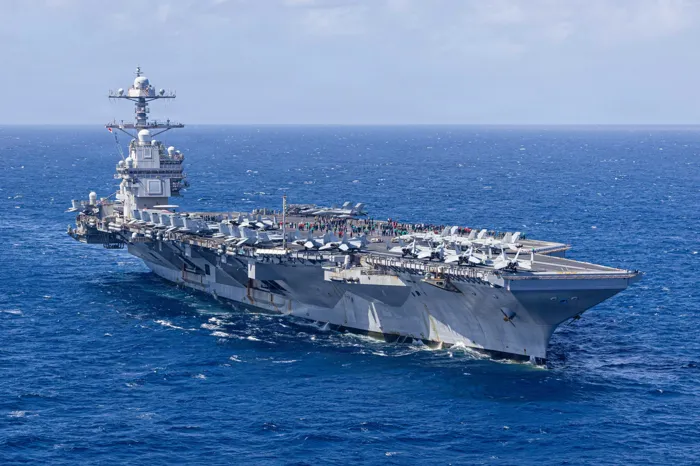
Alongside diplomatic efforts, the United States continues to bolster its military presence in the Middle East. It has recently moved the U.S. aircraft carrier USS Abraham Lincoln closer to Iran and deployed additional Patriot missile batteries and air defense systems, despite indications of flexibility and cooperation from both the American and Iranian sides to initiate serious and responsible negotiations.
Earlier, President Donald Trump called on Tehran via his Truth Social platform to begin negotiations, warning that “time is running out,” a clear reference to the possibility of a military strike against Iran. At the same time, he expressed hope for reaching “a fair and equitable agreement, without nuclear weapons, that serves the interests of all parties,” in his words.
But what does the U.S. military buildup in the Middle East whose withdrawal Tehran demands mean at a time when calls for restraint and diplomacy are growing louder, particularly from the Kremlin and the European Union? The United States has laid out its conditions for negotiations, stating that the door remains open for talks with Iranian officials, while demanding an end to uranium enrichment, stricter limits on Iran’s ballistic missile program, and a halt to its support for regional allies. Iran views these conditions as “unreasonable,” despite expressing readiness to negotiate and end the conflict, especially regarding its ballistic missiles, for which Washington is calling for range limitations a key demand by Israel, which considers it an urgent security issue.
As Iran resists accepting what it describes as “unfair” and “unjust” conditions, Trump continues to threaten military action, warning that “the next attack will be far worse,” even as he acknowledges in media statements that Iran is serious about negotiations and willing to cooperate. Nevertheless, the drums of war continue to beat intermittently, following the 12-day war waged by Israel and the United States from June 13 to June 24 last year.
Commenting on U.S. conditions for successful negotiations, Iranian Foreign Minister Abbas Araghchi wrote on X: “Our forces are ready, with fingers on the trigger. The lessons of the 12-day war have made us faster, stronger, and deeper in our response. At the same time, we remain open to a fair and balanced nuclear agreement without threats or coercion.”
Meanwhile, the European Union, through European Commission spokesperson Anouar El Anouni, urged all states and actors to “respect international law, exercise restraint, and avoid steps that could escalate tensions in the Middle East,” warning that “military escalation carries serious risks to regional stability.” Russia also called on both the United States and Iran to return to the negotiating table and reach an agreement on nuclear weapons. Kremlin spokesperson Dmitry Peskov warned that “the use of force against Tehran could lead to chaos in the region and disastrous consequences,” urging all parties to “exercise restraint and refrain from any use of force to resolve disputes.”
As the possibility of a new war in the Middle East looms, hopes remain pinned on the outcome of renewed negotiations between Washington and Tehran as a crucial step toward fair solutions that serve the interests of the conflicting parties and prevent an escalation threatening regional stability. At the same time, scenarios of war and peace remain uncertain, particularly as many observers view the U.S.-Iranian confrontation as largely a psychological and media-driven conflict.