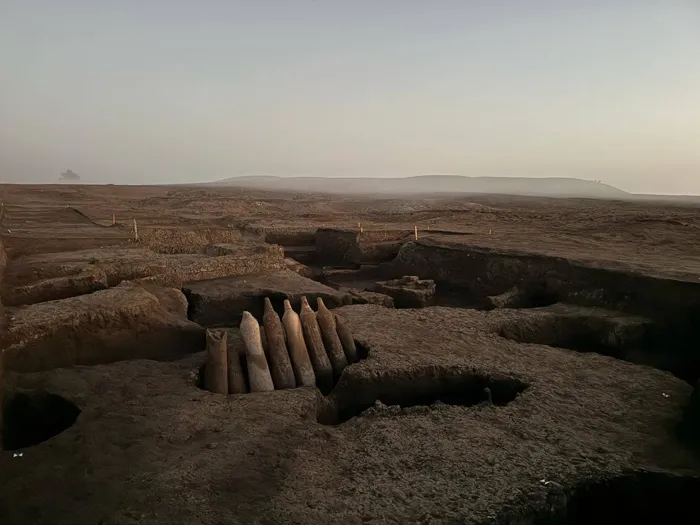
The Egyptian Ministry of Tourism and Antiquities announced on Tuesday the success of a joint Egyptian-Italian archaeological mission in uncovering a complex of industrial workshops dating back to the Late and Ptolemaic periods, in addition to parts of a Roman cemetery, during excavation work at the sites of “Kom El-Ahmar” and “Kom Wasit” in the Beheira Governorate, north of the Egyptian capital.
Mohamed Abdel Badie, head of the Egyptian Antiquities Sector, revealed exciting details about the economic activity of the region; the mission found a huge building containing 6 rooms, two of which were dedicated to processing fish, in addition to finding about 9,700 fish bones, which confirms the existence of a wide industrial activity for the production of salted fish during that period.
The workshops’ activities were not limited to food; the discoveries included rooms for the production of metal and stone tools, faience amulets, unfinished limestone statues, imported amphora jars, and Greek pottery dating back to the fifth century BC.
The mission also uncovered part of a Roman cemetery containing 23 burials in various styles, including direct burial in the ground, pottery coffins, and burials of children inside large amphorae.
Dr. Cristina Mondin, head of the mission from the University of Padua in Italy, said that initial “bio-archaeological” studies on the skeletons of men, women and children indicate that these individuals lived in relatively good living conditions, and showed no signs of serious illness or violence.
In this context, Dr. Mohamed Ismail Khaled, Secretary General of the Supreme Council of Antiquities in Egypt, affirmed that this discovery represents a substantial scientific addition to understanding the nature of settlement life and human activity in the areas surrounding the ancient city of Alexandria, and also provides new insights into regional communication networks from the Late Period to the early Islamic era.