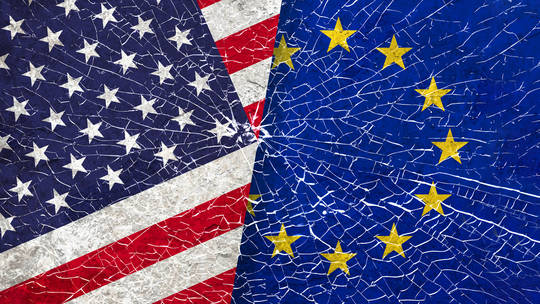
In a Tunis Intellectual Forum: Economists and Researchers Assess the Impact of Trump’s Policies and the New Trade Wars Between the U.S., China, and Europe on Maghreb Countries and the African Continent
Africa News – Monia Ayadi
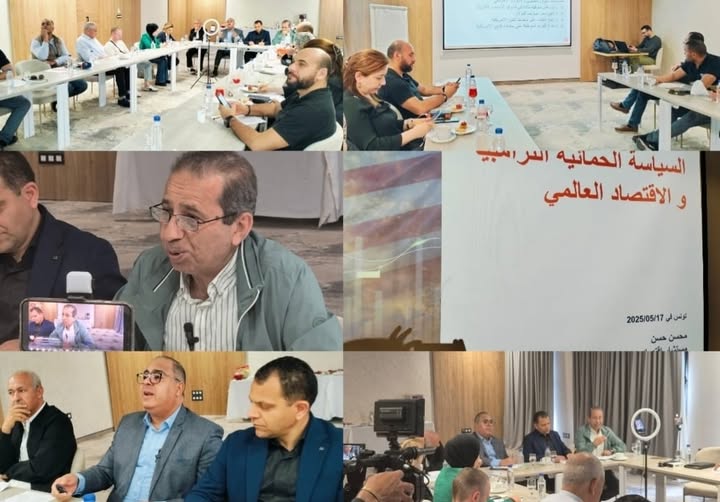
As part of monitoring global geopolitical and economic developments, the Tunisia Association of Competencies, in partnership with the Ibn Rushd Arab-African Forum for Strategic Studies, organized a symposium titled:
“The Impact of Trump’s Policies and the New Trade Wars Between the U.S., China, and Europe on Tunisia, the Maghreb, and the African Continent.”
The event brought together a group of economists, researchers, and academics who analyzed the repercussions of major shifts in global trade policies and the effects of tensions among major powers on emerging economies, particularly Tunisia and Maghreb countries.

Economist Mohsen Hassan: “Tunisia must now more than ever reconsider its bilateral and multilateral trade agreements”
Former Minister of Trade Mohsen Hassan focused on Trump’s protectionist policies and their global economic implications. He explained that Trump imposed high tariffs on imports from China, Canada, Mexico, and the EU, aimed at creating technological dominance and exploiting foreign resources.
Trump’s objective, he said, was to force negotiations—especially with China—rebuild U.S. industry, strengthen exports, and halt China’s rise as a global economic power.
Hassan also discussed Trumpian economic pillars:
-
Dismantling the deep state through restructuring economic and security institutions accused of corruption
-
Digital oligarchy, where a wealthy elite controls both economic and political decisions
He emphasized that Trump’s policies are well-calculated, not random.
These protectionist policies led to:
-
Fluctuations in exchange and stock markets, especially with the yuan and U.S. dollar
-
Decline in demand for U.S. debt bonds and a rise in interest rates
-
Inflationary stagnation caused by rising production costs and declining company profitability, leading to more bankruptcies
Hassan called on Tunisia to revise its trade agreements, including:
-
The free trade agreement with the EU
-
The Agadir Agreement
-
The Arab League agreement
-
The Turkey free trade agreement
He stressed the need for a new economic approach focused on industrial sectors, digital transformation, and AI, while leveraging global trends in economic localization.
He advocated for the slogan “Tunisia First”, protecting fragile sectors and controlling imports—especially of unnecessary consumer goods.

Ridha Chkandali: “U.S. tariffs’ inflationary effects may prevent Tunisia’s central bank from lowering interest rates”
Economist and university professor Ridha Chkandali described the U.S. protectionist measures as an “economic play” staged by Trump to restore America’s prestige in the face of rising powers like China, whose growth rate is around 4%, compared to America’s 1%.
He explained that the goal was to push other countries into negotiating tariff reductions:
-
China cut its tariffs on goods to the U.S. from 54% to 30%
-
In return, U.S. tariffs on Chinese goods dropped by 10%
Chkandali warned that these measures may lead central banks, including the ECB, to raise interest rates again to counter inflation—
Which could hinder the Tunisian Central Bank from lowering its key rate.
He too called for a review of trade agreements—especially with the EU and Turkey—pointing out that the high tariffs on Turkish goods have harmed Tunisia’s textile sector, particularly since it relies on importing cotton and semi-finished materials from Turkey.

Moncef El Sellimi: “Europe must reassess its ties with the Maghreb and Africa”
Journalist and researcher Moncef El Sellimi, expert on Maghreb-European relations, stressed that the region is now a battlefield of influence between Europe, the U.S., China, and regional powers like Turkey, Israel, and Iran.
He warned that Europe will pay a price if it continues neglecting the Maghreb.
Currently, Europe maintains:
-
Over 70% economic influence in the region
-
Strategic and security interests (migration, terrorism, organized crime, cyber threats)
Despite its focus on Eastern Europe amid the Ukraine crisis, the EU must maintain engagement with the Maghreb and Africa to avoid losing more ground to rival powers and the consequences of internal Maghreb conflicts (Morocco-Algeria tensions, Libya crisis).
Asia Atrous: “For the U.S., interests outweigh eternal enemies”
Asia Atrous, editor-in-chief of international affairs at Assabah, noted that the U.S. has over 1,000 trade representatives in its embassies worldwide to promote its exports.
She emphasized that the recent U.S.-Gulf summit demonstrated how America has no eternal enemies—only strategic interests matter.
She described Trump as acting like a global emperor, trying to impose his will economically, militarily, and politically.
However, she lamented that Tunisia has failed to:
-
Leverage its ties with the Maghreb or Africa
-
Create a favorable climate for local and foreign investors