The Failure of the War Against Iran and the Thwarting of the “Greater Israel” Project
By Monia Ayadi

Russian Foreign Minister Sergey Lavrov’s visit to Tehran and his meetings with Iranian President Masoud Pezeshkian and his counterpart, Abbas Araghchi, on October 19, 2026, come amid ongoing regional escalation in which military, political and economic considerations intersect. The Strait of Hormuz and energy markets are becoming increasingly important as Israeli elections and the U.S. congressional midterm elections, scheduled for November 3, approach. These developments give the visit a significance that extends beyond bilateral relations between Moscow and Tehran, placing it within the broader context of competition over the future of regional balances and the limits of American and Israeli influence in the Middle East.
Through its diplomatic moves, Russia seeks to strengthen its position as an influential actor in efforts to contain the crisis and preserve its strategic partnership with Iran, while managing its relations with Arab countries and other international powers. Tehran, for its part, is seeking to leverage its relations with Moscow to expand its political room for maneuver, reaffirm its ability to continue the confrontation, and pursue regional arrangements that do not rely on imposing conditions through military force.
The United States and Israel, meanwhile, face a challenge concerning the extent to which military operations can achieve sustainable political and security objectives, particularly if they fail to bring about a fundamental change in Iran’s behavior or impose a settlement consistent with American and Israeli interests. However, assessing the outcome of the war remains dependent on evaluating its military and political results and cannot be reduced to the continuation of hostilities or the scale of losses suffered by the parties.
This raises the central question: Does Lavrov’s visit represent a step toward reshaping the balance of power in the region, or is it primarily a diplomatic move aimed at protecting Russian and Iranian interests amid a crisis whose costs are increasing for all parties?
Moscow and Tehran: A Strategic Partnership and Messages Beyond Bilateral Relations
During his meeting with Sergey Lavrov, Iranian President Masoud Pezeshkian stressed the need to accelerate the implementation of agreements concluded between the two countries and expand cooperation in energy, transportation, trade and investment. He also emphasized opposition to imposing political will through force, calling for international relations based on mutual respect, cooperation and multilateralism.
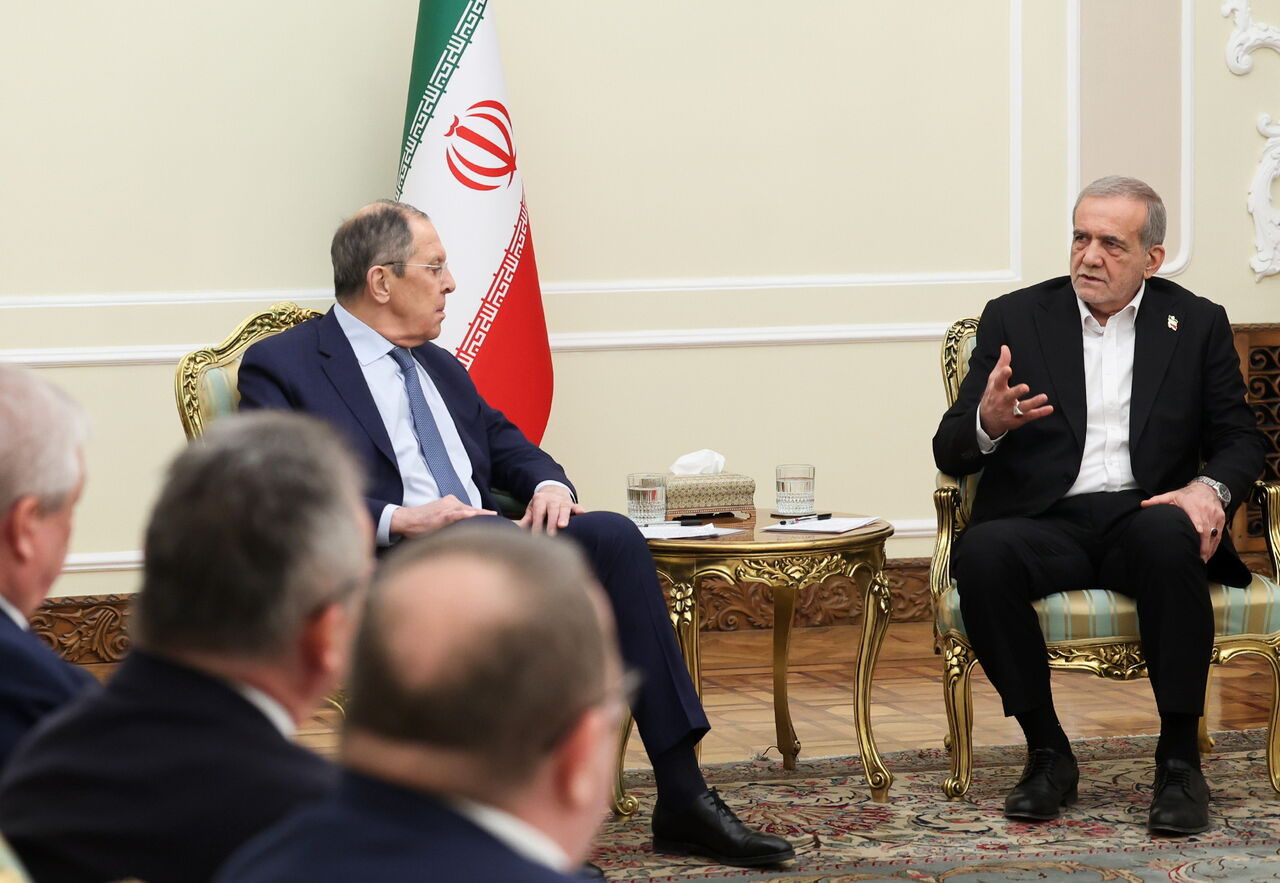
On regional affairs, Pezeshkian criticized the presence of U.S. military bases in the region, arguing that they contribute to increasing tensions and insecurity. He called for strengthening dialogue among regional countries and developing joint mechanisms to address their disputes. These positions are consistent with Iran’s vision of reducing dependence on foreign military presence and establishing regional security arrangements involving the countries concerned.
For his part, Iranian Foreign Minister Abbas Araghchi stressed the importance of diplomatic solutions to regional crises during a joint press conference with Lavrov. He noted that Tehran and Moscow agreed on the need to address outstanding issues without military escalation. The discussions also covered ways to strengthen political and economic coordination and develop cooperation on regional and international issues.

Lavrov, in turn, reaffirmed Moscow’s willingness to continue implementing the agreements concluded with Tehran and strengthen cooperation in energy, transportation, investment and trade, while maintaining coordination on international issues. These statements fall within the framework of the comprehensive strategic partnership concluded by the two countries in January 2025, which covers several areas, including economic, security and defense cooperation.
The importance of this partnership, however, does not mean that the two countries have a binding military alliance requiring direct intervention if either party comes under attack. The strategic cooperation agreement between Russia and Iran contains no mutual-defense clause obliging either country to go to war to defend the other. This is a crucial distinction when assessing the limits of Russian support for Tehran.
Moscow operates according to calculations that extend beyond the Iranian issue, including its war in Ukraine, its relations with the United States and China, its economic interests in the Gulf, and its desire to maintain channels of communication with Arab capitals. Strengthening cooperation with Iran, therefore, does not necessarily mean that Russia is prepared to enter into a direct military confrontation with Washington or Tel Aviv.
This reality raises questions about the nature of Russia’s role: Can Moscow turn its partnership with Tehran into an influential instrument in shaping the course of the war and the political settlement, or will its capacity remain primarily dependent on diplomatic initiatives and economic and strategic coordination?
The War Against Iran: Have the Hopes for a Decisive Military Victory Failed?
The confrontation with Iran has revived a longstanding issue in international relations: the limits of military power and its ability to achieve long-term political objectives. Superiority in weaponry, air capabilities and technology does not, by itself, guarantee the subjugation of a state or the imposition of a lasting settlement, particularly when the targeted country has well-established military and security institutions, missile capabilities, regional pressure tools and a geographical position that enables it to influence trade and energy flows.
From this perspective, assessing the outcome of the war should not be limited to the military or economic losses suffered by the parties. It also requires examining the extent to which the declared objectives of the operations have been achieved, the impact of the confrontation on deterrence capabilities, the future of Iran’s nuclear program, Tehran’s regional position, and the parties’ ability to impose sustainable security and political arrangements.
If military operations fail to bring about a lasting strategic change in Iran’s behavior or eliminate the security concerns that Washington and Tel Aviv have cited to justify their actions, the United States and Israel may find themselves facing a more complex equation. This could require them to reassess the merits of continuing the escalation and seek a political path that achieves at least some of their objectives.
However, Iran’s continued resistance is not, in itself, sufficient to prove that the war has failed, just as military superiority alone is not enough to demonstrate its success. The final assessment will depend on the results of the operations, whether Iran’s capabilities have weakened or remain intact, the nature of any settlement that may be reached, and whether such a settlement addresses the causes of the conflict or merely postpones its recurrence to a later stage.
In this context, Russian initiatives acquire additional significance if they can help open channels of negotiation or provide a diplomatic framework that makes de-escalation possible. Moscow’s ability to influence the course of the war will nevertheless remain dependent on the positions of Washington, Tehran and Tel Aviv, as well as the calculations of Arab countries directly concerned with Gulf security and regional stability.
The Strait of Hormuz and Energy Markets: Economic Interests at the Heart of the Conflict
The Strait of Hormuz is one of the world’s most important strategic maritime passages because of its role in transporting oil and gas from Gulf countries to international markets. Any disruption to navigation through the strait therefore affects not only the countries bordering it, but also energy-importing economies, shipping companies, insurance markets and global supply chains.
Recent developments have shown that the risks associated with the strait have moved beyond the realm of theoretical possibilities, with an increase in attacks on ships, disruptions to maritime traffic and rising transportation costs. Reports published on October 19 indicated that maritime attacks had contributed to growing concerns about energy supplies, as the price of Brent crude approached $108 per barrel, according to one report, amid market fluctuations.
The repercussions of these developments vary according to the nature of the economies concerned. Energy-importing countries face the risk of higher import bills and increased production and transportation costs, with potential inflationary pressures. Producer countries, meanwhile, may benefit from higher prices under certain circumstances, but such gains are not guaranteed. They depend on export volumes, the ability to deliver supplies to markets, insurance and shipping costs, and the risk of production disruptions.
For Russia, these developments are particularly significant given the role of oil and gas exports in its economy and trade relations. Higher prices may provide Moscow with additional economic room for maneuver, but this does not mean that the continuation of the crisis serves its interests unconditionally. Disruptions to international trade and slower global economic growth could impose offsetting costs on the Russian economy and its partners.
Continuing tensions in the Gulf also offer Moscow an opportunity to strengthen its diplomatic presence, particularly if it can maintain communication with Iran, Arab countries and the United States. However, the success of this role requires more than exchanges of statements; it calls for practical steps to ensure the safety of navigation and limit the risk of the confrontation expanding.
Iran’s geographical position, meanwhile, gives it considerable influence over Gulf security calculations, but it also leaves its economy and commercial interests exposed to the consequences of escalation. Disruptions to navigation and higher transportation costs do not affect other countries alone; they can also intensify economic pressures on Tehran itself.
Accordingly, the call to restore stability in the Strait of Hormuz is not merely a political or diplomatic demand. It is directly linked to economic interests and to the need for international markets to ensure the uninterrupted flow of energy and avoid a wider supply crisis.
Trump and Netanyahu: Elections Put the Cost of Confrontation to the Test
Lavrov’s visit to Tehran comes at a politically sensitive time for Washington and Tel Aviv, coinciding with the approaching Israeli elections scheduled for October 27 and the U.S. congressional midterm elections set for November 3, 2026. In the United States, these elections are not a presidential contest, but they may affect the balance of power in Congress and the administration’s ability to pass its policies. They also represent a political test for President Donald Trump.
The Iran issue remains one of the matters that could influence political debate in the United States, given its connection to the security of American forces in the region, relations with Israel, the cost of military operations, fuel prices and the risk of becoming embroiled in a prolonged war.
The Trump administration faces a complex equation. On the one hand, the imperatives of deterrence, protecting allies and safeguarding American interests require it to demonstrate firmness toward Tehran. On the other hand, the economic and military costs of the war could become a source of domestic pressure, particularly if energy-market disruptions persist or the administration is unable to present clear results to the public.
In this context, rising oil prices and disruptions to navigation in the Gulf could influence the mood of American voters, especially if they feel that the confrontation is increasing the cost of living without achieving clearly defined political objectives. However, it cannot be asserted with certainty that these developments will lead to electoral losses for Republicans. Election results are also influenced by economic issues, immigration, healthcare and domestic policies, as well as differences in voter priorities from one state to another.
In Israel, calculations related to the war intersect with considerations of national security, deterrence and the government’s political future. The persistence of the Iranian threat or the failure to achieve declared objectives could intensify domestic debate over the effectiveness of the military strategy and its ability to deliver sustainable results.
Nevertheless, the political impact of the confrontation cannot be measured by statements alone. It depends on the results on the ground, the Israeli public’s sense of security, the scale of losses and economic costs, and the government’s ability to convince public opinion that the war’s objectives have been achieved.
The question, therefore, is not only whether Lavrov’s visit will disrupt Trump’s and Netanyahu’s calculations, but also whether it can influence the strategic environment in which Washington and Tel Aviv operate, and whether it will help push the parties toward negotiations or remain a diplomatic move with limited impact.
“Greater Israel”: Between Ideological Visions and Political Reality
The discussion surrounding the “Greater Israel” project has a political and ideological dimension that extends beyond the direct confrontation with Iran. It is linked to debates over the borders of the Israeli state, expansionist visions held by certain political and religious movements, the future of Palestinian territories, and the nature of regional arrangements that Israel seeks to impose.
However, the term does not refer to a single plan shared by all Israeli political currents. Its meaning and scope vary according to the political and ideological context in which it is used. Treating it as a unified project with clearly defined objectives and implementation mechanisms therefore requires clear evidence regarding the nature of the visions concerned and the actors who support them.
At the same time, Arab concerns about Israeli expansion are not based solely on ideological terminology. They are linked to developments on the ground, including the continuation of the occupation, settlement expansion, military operations in Palestinian territories and the widening of regional confrontations. These developments raise concerns about sovereignty, security and stability.
From this perspective, the outcome of the war against Iran could affect Israel’s ability to reshape its surrounding strategic environment. If Tehran retains significant military and deterrent capabilities and continues its relations with other regional actors, this could limit Israel’s ability to impose regional arrangements through force alone.
This possibility does not mean, however, that the “Greater Israel” project has been thwarted. Nor can the outcome of the confrontation with Iran be considered conclusive evidence that expansionist tendencies among certain Israeli political currents have come to an end. The future of these tendencies is influenced by several factors, including domestic political balances, the position of the United States, developments in the Palestinian issue, the positions of Arab countries and the international community’s ability to enforce international law.
Accordingly, the more accurate criterion is not to proclaim a political or ideological victory based solely on the outcome of the war, but to monitor whether developments lead to tangible changes in Israeli policies, limit military operations and settlement expansion, and open a political process that guarantees Palestinian rights and respects the sovereignty of countries in the region.
Arab Capitals Facing the Equation of Security and Sovereignty
Regional developments place Arab capitals before a complex equation combining security concerns, economic interests, defense relations with the United States and the desire to avoid an open war that could threaten regional stability.
Some Arab countries regard Iranian influence, its missile programs and its relations with armed groups in the region as sources of threat to their national security. Other countries prioritize containing the escalation, maintaining channels of dialogue and preventing a confrontation that could affect their vital infrastructure, ports and maritime routes.
These calculations are particularly evident in the Gulf countries, which face a dual challenge: protecting their territories and infrastructure while maintaining the uninterrupted flow of energy exports and maritime trade. Continued disruptions to navigation in the Strait of Hormuz could impose direct costs on Gulf economies, affect investor confidence and make economic planning more difficult.
At the same time, many Arab countries maintain defense and economic partnerships with the United States, while other capitals seek to diversify their international relations and strengthen cooperation with Russia, China and other global powers. Such diversification does not necessarily mean moving from one bloc to another. In many cases, it reflects an effort to expand their independence in decision-making and protect national interests.
From this perspective, closer Russian-Iranian ties could offer an opportunity for Arab diplomacy if they help open channels of negotiation and reduce escalation. They could, however, further complicate the situation if they become an additional factor in international and regional polarization.
Addressing these challenges requires broader Arab coordination on Gulf security, freedom of navigation, relations with Iran and the future of regional security arrangements. It also requires addressing concerns about Iran’s nuclear program, missiles and regional relations through an approach that goes beyond military confrontation to include dialogue, reciprocal guarantees and respect for state sovereignty.
Sustainable regional security cannot be built by ignoring the concerns of any party, just as it cannot be achieved by imposing security arrangements that the countries concerned do not accept. Regional stability requires clear mechanisms to prevent escalation and resolve disputes, guarantee the safety of navigation and vital infrastructure, and address the root causes of political crises that make renewed confrontation possible.
Can Lavrov’s Visit Reshape the Balance of Power?
Sergey Lavrov’s visit to Tehran reveals Russia’s desire to maintain an active role in the Middle East’s balance of power, alongside Iran’s efforts to strengthen its partnership with Moscow and expand its political and economic room for maneuver. The talks also reflect a growing recognition that continued confrontation threatens interests extending beyond the borders of the countries at war, affecting energy markets, international trade and the security of maritime routes.
However, moving from political coordination to actual strategic change depends on the two countries’ ability to translate agreements and statements into practical steps, as well as the willingness of the United States, Israel, Iran and Arab countries to engage with diplomatic initiatives.
A single visit is not enough to demonstrate a shift in the balance of power or the collapse of American and Israeli strategy. Nor do the available facts justify concluding that the war against Iran has definitively failed or that the “Greater Israel” project has come to an end. Such conclusions require a broader assessment of military and political outcomes and of the changes that may occur in the behavior and positions of the parties involved.
Conversely, continuing the confrontation without a political settlement threatens to prolong instability, deepen regional divisions, increase security and defense costs, and expand the crisis’s repercussions for the global economy. Disruptions to energy supplies and maritime traffic could become an additional source of pressure on governments, particularly if they affect prices, inflation and economic growth.
If, on the other hand, Russian and Iranian initiatives, in cooperation with other regional and international actors, succeed in promoting de-escalation and resuming negotiations, they could open the way to reassessing military options and seeking more stable arrangements. The success of any negotiating process, however, will depend on its ability to address fundamental disagreements rather than merely secure a temporary halt to military operations.
Ultimately, the outcome of Lavrov’s visit will not be measured by the force of the statements issued during it, but by its impact on the course of events: Will it help contain the confrontation and pave the way for a political settlement, or will it remain another diplomatic stop in a conflict shaped by international interests, electoral calculations and the concerns of Arab capitals, while the region remains vulnerable to new waves of escalation?