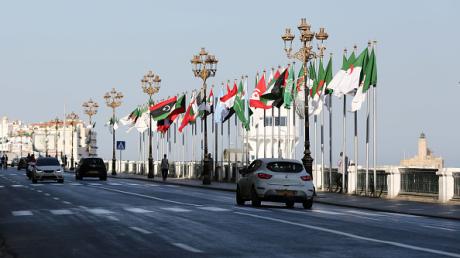

Before Algeria reached the decision to sever relations with the United Arab Emirates, announced on Thursday, a series of episodes of political tension had already emerged. Some were public, while others remained unspoken or were only hinted at politically and in the media. All of them, however, added further factors of tension, gradually pushing the two countries toward a political and diplomatic rupture.
Following the presidential election held in Algeria on December 12, 2019, political and media reports emerged about an alleged Emirati attempt to interfere in the presidential election in favor of a particular candidate, former Culture Minister Azzedine Mihoubi, who was then serving as secretary-general of the National Rally for Democracy (RND). Years later, an official confirmation came in February 2026, when Algerian President Abdelmadjid Tebboune said in an interview broadcast by state television that “a state, or rather I would call it a micro-state” referring to the UAE “wanted to intervene in the first presidential election, and then the second.”
In January 2020, UAE Foreign Minister Abdullah bin Zayed visited Algeria to discuss the tense situation in Libya. Political differences did not allow the discussions to continue for long. Algeria’s foreign minister at the time, Sabri Boukadoum, said that “the talks were unfortunately short.” The UAE supported the forces of retired Libyan commander Khalifa Haftar, while Algeria considered his offensive against the Libyan capital, Tripoli, a “red line.” During the visit, Minister bin Zayed also conveyed an invitation to the Algerian president to visit the UAE. Tebboune did not accept the Emirati invitation, leaving Abu Dhabi as the only Arab capital in the Gulf that he had not visited.
In April 2020, the French newspaper Le Monde, citing a diplomatic source working at the United Nations headquarters in New York, reported that the UAE had led a regional coalition that blocked the appointment of former Algerian Foreign Minister Ramtane Lamamra as the UN envoy to Libya, replacing Lebanese diplomat Ghassan Salamé.
In September 2020, relations between the two countries underwent a major turning point after Tebboune sharply criticized the normalization agreements signed by the UAE, Bahrain and Morocco with Israel under the Abraham Accords, describing them as a “rush.” No official Emirati response was issued at the time, but UAE officials, including then Minister of State for Foreign Affairs Anwar Gargash, made angry comments in response to Tebboune’s statements.
In March 2021, UAE authorities detained former Sonatrach Director General Abdelmoumen Ould Kaddour and refused to hand him over to Algeria. They eventually extradited him under significant Algerian pressure, following five months of negotiations between Algeria and the Emirati authorities, in August of the same year.
In January 2022, former Algerian Foreign Minister Ramtane Lamamra visited Abu Dhabi. The visit took place as part of preparations for the Arab summit held in Algiers in November of that year. Some bilateral issues were also discussed during the visit. However, UAE President Mohammed bin Zayed did not attend the Algiers summit.
In March 2023, Algeria received Major General Mubarak Saeed Ghafan Al Jabri, Assistant Undersecretary for Support and Defense Industries at the UAE Ministry of Defense, to participate in a meeting of the Algerian-Emirati Joint Committee responsible for military cooperation. The discussions focused on the future of a cooperation project involving the manufacture of military vehicles and armored vehicles in Algeria, with the participation of German automaker Mercedes-Benz, amid Algeria’s desire to exclude the UAE from the project.
In June 2023, the state-owned television channel Ennahar broadcast an alleged false report based on a forged statement attributed to the Foreign Ministry. The statement claimed that Algeria had decided to expel the UAE ambassador from Algeria and given him 48 hours to leave the country. The incident led to the dismissal of Communications Minister Mohamed Bouslimani. Algerian Foreign Minister Ahmed Attaf was subsequently forced to hold a telephone conversation with his Emirati counterpart, Abdullah bin Zayed, to clarify the situation.
In January 2024, Algeria’s National Security Council issued a strongly worded statement implicitly accusing the UAE referred to in the statement as a “brotherly Arab country” of playing a role in regional tensions and pursuing hostile behavior toward Algeria. The statement was regarded as a final warning.
During the same period, Algeria’s state radio reported that “the United Arab Emirates had provided 15 million euros to launch a media campaign and disseminate false news and biased propaganda aimed at creating a charged atmosphere in relations between Algeria and the Sahel countries.”
In May 2024, Algerian President Abdelmadjid Tebboune and UAE President Mohammed bin Zayed met and held direct talks, without the meeting having been scheduled in advance, on the sidelines of a G7 summit meeting, after a period of strained relations between the two countries.
In September 2024, Presidents bin Zayed and Tebboune held a telephone conversation following Tebboune’s re-election to a second presidential term in the election held in September 2024. They agreed “to meet soon.”
In January 2025, Algeria accused the UAE, through a newspaper close to the Algerian presidency, of what it described as “hostile actions and unprecedented activities aimed at destabilizing Algeria by supporting elements hostile to national unity and supporting and financing a separatist movement, after official information and ongoing investigations in France indicated Emirati funding of the MAK movement.”
The reference was to the Movement for the Self-Determination of Kabylie (MAK), led by Ferhat Mehenni, which the Algerian authorities classify as a terrorist organization.
During the same period, President Tebboune confirmed that Algeria had received threats from the UAE over economic disputes concerning decisions taken by Algeria regarding Emirati investments in the country, including a tobacco company, Algerian ports and an automobile manufacturing company affiliated with the military. He said: “They are threatening us with international arbitration.”
On February 2, 2026, Algeria’s Ministry of Transport announced the cancellation of the agreement on air services with the United Arab Emirates, signed in Abu Dhabi on May 13, 2013. This means that Emirati airlines were no longer entitled to operate flights to or from Algeria, land at Algerian airports, or exercise the right to fly through Algerian airspace. In practice, Emirati airlines ended their flights to Algeria on August 29.
On July 19, 2026, a newspaper close to the Algerian presidency reported that Algeria was preparing to announce its decision to sever diplomatic relations with the UAE.
On July 28, the Algerian president, in an interview broadcast by state television, said that Algeria had delayed the decision to sever relations with the UAE for Arab considerations. He said at the time: “The Arab world has many cracks and divisions, and we do not want to make matters worse. Otherwise, we would have severed relations with this micro-state a long time ago.”
Today, September 10, 2026, the Algerian Ministry of Foreign Affairs announced the decision to sever diplomatic relations with the United Arab Emirates, citing what it described as “an increase in provocative or hostile actions emanating from the United Arab Emirates,” as well as “the exhaustion of all avenues capable of preserving bilateral relations.”