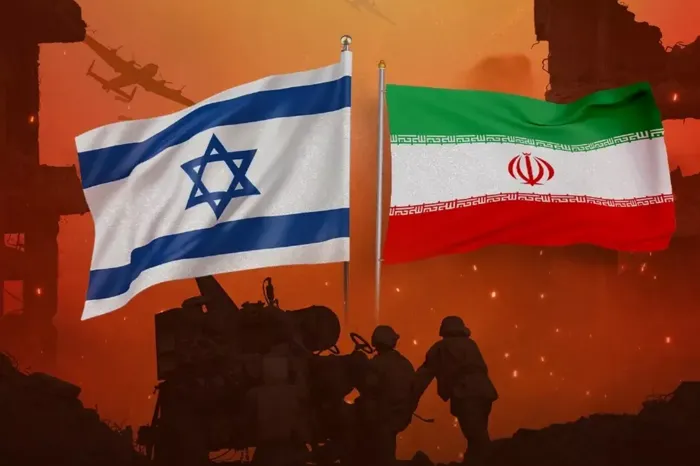
The situation in the Middle East is witnessing a large-scale military escalation, considered the most dangerous during the recent rounds of regional confrontation, with the continued exchange of direct strikes between the United States and Israel against Iran and the extension of the strikes to a number of countries in the region.
Sources familiar with the military operation launched by Israel and the United States against Iran reported that so far, 2,000 Iranian targets have been targeted since the start of the joint military campaign against Iran on Saturday morning. The Israeli occupation army announced that it had launched thousands of shells and carried out more than 700 sorties over Iran since Saturday morning, according to the Wall Street Journal.
Major General Ayman Abdel Mohsen, a specialist in military and strategic affairs, revealed to “Cairo News” the implications and dimensions of the military operation, as follows:
Choosing the timing of the attack:
Major General Ayman Abdel Mohsen said that, contrary to previous and earlier timings, the timing of 8:20 AM Tehran time was a suitable choice for the operation (a holiday in Israel – the beginning of the work week in Iran and a time of intensive movement of employees in state institutions), and the implementation by the American forces of the military operation called “Epic Wrath” to target and prevent Iranian threats, as the American fighters carried out air raids, followed by missile strikes from the ground, and warships in the Gulf, and Iran announced that its territory was subjected to widespread attacks.
Targets that were hit
1- The capital, Tehran: the administrative center of the state, where military command headquarters and sites belonging to the Revolutionary Guard were struck, in addition to areas close to the headquarters of the Supreme Leader, which resulted in the death of the Supreme Leader “Khamenei” and a number of leaders who were with him.
2- The city of Isfahan, which includes nuclear facilities and energy centers.
3- The coastal city of Bushehr, which houses nuclear facilities and uranium enrichment facilities.
4- The city of Qom is considered the most prominent religious center in the country and the headquarters of senior clerics.
5- Karaj city, located near Tehran, contains military warehouses and supplies.
He explained that the attacks extended from the east of Iran to its west, with the implementation of the first phase of Operation “Zair al-Asad” with crushing preemptive Israeli strikes on sensitive military and political targets, along with the expansion of assassination operations against a number of political and military leaders, most notably “targeting the headquarters of Supreme Leader Ali Khamenei, the killing of Iranian Defense Minister Aziz Nasirzadeh, the killing of Revolutionary Guard Commander Mohammad Pakpour, Admiral Ali Shamkhani, Secretary of the Defense Council, and Salah Asadi, a senior intelligence officer in the Supreme Command of the Iranian forces.”
Strike targets
The strategic expert explained that the Iranian response came about two hours after the attacks began, at 10:20 AM, with the implementation of the operation to respond to the American-Israeli strikes, which was called “True Promise 4,” and included the launching of Iranian missiles towards several locations in the region.
Among the most prominent targets that Iran announced it had struck outside of Israel were four American bases and US-affiliated sites:
1- Al Udeid Air Base in Qatar.
2- Ali Al Salem Air Base in Kuwait.
3- Al Dhafra base in the United Arab Emirates.
4- The headquarters of the US Fifth Fleet is in Bahrain.
Consequences of the war
He added that, in addition to sites in Jordan, Oman, Kuwait, the UAE and Riyadh, as a message to America that it will be followed by an intensification of targeting and impact, inside Israel, Iranian short-range missiles up to 500 km were launched to different areas, in northern Israel in the Galilee and Haifa, facilities in the Negev and the vicinity of Dimona in central and southern Israel, which will be followed by ballistic and hypersonic missile strikes on precise and impactful targets in Israel.
He pointed out that with the continued exchange of blows, the regional situation is witnessing an expansion of the scope of confrontations to include a number of Gulf and Levant countries. This escalation raises fears of the region sliding into a comprehensive war that may exceed the limits of the current confrontation, and the repercussions of this on the region in particular and the world in general, politically by violating the sovereignty of states, and economically by the rise in oil prices – the cessation of tourism and investments – and the impact on global trade from the closure of the Strait of Hormuz by blocking a large part of global oil exports.
The outcome of the intensive efforts and communications to impose political and diplomatic solutions with the parties at the Egyptian, regional and international levels remains to be seen, in order to restore stability, reduce escalation and avoid a full-scale war due to its futility.