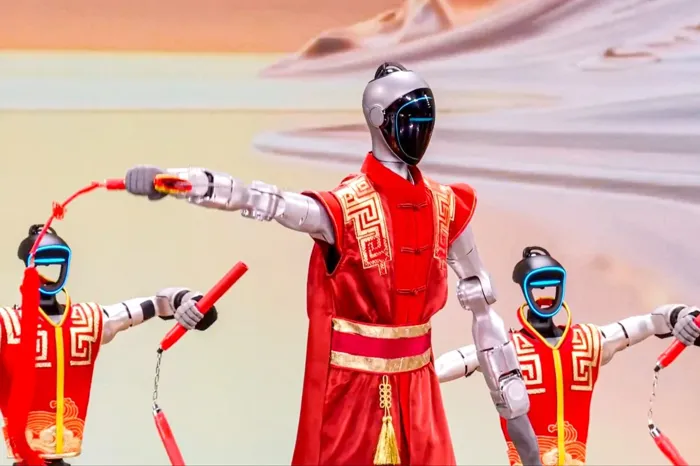
Dancing humanoid robots headlined the Chinese Spring Festival celebrations, performing impressive stunts that included backflips, rapid twists, and kung fu moves, without any of them falling on stage, in a scene that impressed the audience and opened the door to questions about the future capabilities of this technology.
Compared to last year’s offers
Clips from the show quickly spread on social media, comparing it to last year’s show, which also featured dancing robots, but with simpler movements limited to walking, turning, and kicking.
The British newspaper “The Guardian” believes that the remarkable improvement in movements this year reflects progress in artificial intelligence capabilities and control systems, as part of China’s efforts to strengthen its position in the global technology race.
Propaganda dimensions
Kyle Chan, a China technology researcher at the Brookings Institution in Washington, told the newspaper that Beijing uses these public displays to impress local and international audiences with what it describes as its technological superiority.
He added that humanoid robots represent a visual and easy-to-understand model for showcasing technological progress, unlike artificial intelligence models or complex industrial equipment.
He explained that humanoid robots are an area where China can claim an advantage over the United States, particularly in terms of the ability to scale up production.
For his part, George Stiller, head of robotics and automation at a global technology consulting firm, considered that what distinguished the event was “the direct transition from industrial policies to a prime-time public spectacle,” referring to the link between Chinese industrial strategy and media messages.
Industrial readiness
Despite the praise for the technical level, experts cautioned against over-interpreting the performance’s significance. Steller pointed out that a theatrical performance does not necessarily equate to complete industrial capability, explaining that these robots have been trained on the same routines hundreds or thousands of times and cannot easily alter movements or adapt to unstructured environments.
He pointed out that the dance movements are based primarily on “learning by imitation” techniques and balance-maintenance systems, and do not necessarily reflect the ability of robots to work stably in factories or complex environments, where the issue of motor precision and dealing with unexpected conditions remains a challenge.
Broader industrial strategy
The presentation revealed China’s broader technological ambitions, with official data indicating that by the end of 2024, some 451,700 companies specializing in intelligent robots had been registered, with a total capital of 6.44 trillion yuan (about $932 billion).
Initiatives such as “Made in China 2025” and the 14th Five-Year Plan are among the most prominent frameworks that have placed robotics and artificial intelligence at the heart of Beijing’s strategic priorities.
Morgan Stanley predicted that sales of humanoid robots in China would double to 28,000 units by 2026. American businessman Elon Musk also stated that the biggest potential competitor to his company in the field of humanoid robots would be Chinese companies, at a time when his company Tesla is working on developing its humanoid robot “Optimus”.
For her part, Marina Chang, a professor of technology at the University of Technology Sydney, believes that this broad public demonstration may indicate that China is entering a new phase in its industrial plan, where robots become a key focus in the transition from low-cost manufacturing to high-value smart manufacturing.