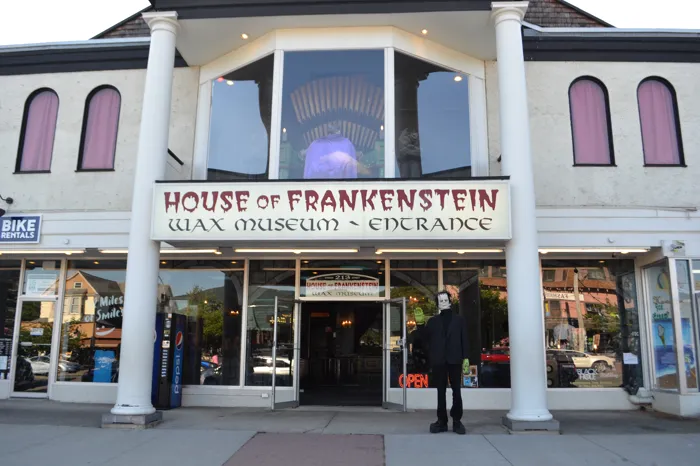
Passersby may be frightened by the window of a house in the city of Bath in southwest England, as it displays pictures indicating what is inside: the House of Frankenstein Museum and Mary Shelley, the famous writer and her most famous Gothic novel published in 1818.
Mary Shelley’s (1797–1851) novel “Frankenstein” is a cornerstone of horror and science fiction literature. Written at the age of eighteen as a result of a literary challenge, this Gothic novel explores the consequences of scientific arrogance and moral responsibility. The scientist Victor Frankenstein creates a living being from the remains of the dead, then abandons it, leading to a series of tragedies stemming from loneliness and social rejection.
For nearly two hundred years, that novel has inspired many film and television adaptations, the most recent being an Oscar-nominated film by Mexican director Guillermo del Toro, according to Reuters.
Chris Harris, co-founder and director of the museum, said: “Frankenstein is one of the most important books in English literature… It is the world’s first science fiction novel.”
Despite its age, Harris sees it as “a very contemporary story… He tries to fit in, but he is rejected… and faces prejudice and bias against him. Then you think… well, this injustice leads to violence, which is something that is happening in the present time.”
Shelley, whose real name was Mary Wollstonecraft Godwin, conceived the idea for “Frankenstein or the Modern Prometheus” when she was eighteen. She and her future husband, the poet Percy Bysshe Shelley, were staying by Lake Geneva in 1816 with Lord Byron when he and a group of companions challenged her to write a horror story. It was there that she found her inspiration.
After returning to England, she moved to Bath where she wrote the main chapters of the book about the scientist Victor Frankenstein creating a composite creature from the remains, before finishing the novel in the town of Marlow.
The museum features a lifelike, robotic model of the creature standing in a replica of Victor Frankenstein’s laboratory. Elsewhere, visitors learn about Shelley’s life, the tragedies she faced, and her passion for science.
Harris said of the novel and the creature’s character, “It plays on people’s fears of change, and now Frankenstein is a metaphor for anything we are afraid of.”
He pointed out that the first adaptation of the novel was a musical that turned this creature into a silent monster that kills people, while Shelley portrayed it in her book as “sensitive and talking.”
He added that it would be interesting to see how Del Toro would portray a different side of the novel and the creature with his vision, given that so many works have been adapted from the same idea over time.
The film, which received nine Oscar nominations including Best Picture, portrays the character of “The Creature,” played by actor Jacob Elordi, as kind and thirsty for knowledge, but facing resentment and rejection.
Elordi received nominations for Best Supporting Actor at the Oscars and the BAFTA Film Awards on Sunday, Britain’s top film awards, with Frankenstein receiving eight nominations.
While del Toro’s film differs from the book in several aspects, including the omission of the creature’s murders, Harris says that in terms of physicality it is a “similar reproduction” of Shelley’s description.