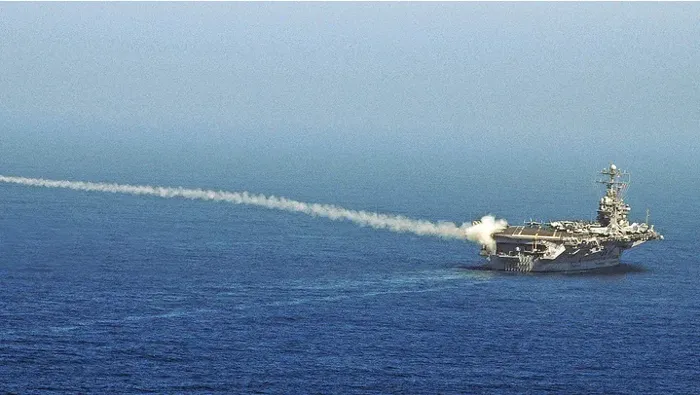
A Canadian company specializing in the development of unmanned aircraft systems has warned that Iran’s low-cost drone swarms pose a real threat to high-value US naval assets, including the USS Abraham Lincoln carrier strike group, amid escalating tensions between the two countries.
defensive warnings
Cameron Chell, CEO and co-founder of drone manufacturer Dragonfly, said Iran’s growing reliance on low-cost drone systems poses a real threat to advanced U.S. naval assets, including the USS Abraham Lincoln carrier strike group.
Draganfly, based in Vancouver, Canada, makes its business of developing drone solutions and systems for various sectors, including public safety, agriculture, industrial inspections and mapping.
According to Fox News, Chell explained that Iran’s drone capabilities are estimated to be worth tens of millions of dollars, noting that the combination of low-cost warheads and inexpensive launch platforms has created an effective asymmetric threat.
He added that Iran has developed this threat through remotely controlled aircraft, which allow for intensive attacks against highly sophisticated military systems, stressing that this pattern of attacks represents a real challenge to conventional defenses.
Drone tactics
Chill noted that Iran is capable of launching large numbers of relatively unsophisticated drones directly at naval vessels, resulting in intense attacks that could overwhelm currently deployed conventional defense systems.
He said, “Launching hundreds of drones in a short period of time makes it almost certain that some of these drones will succeed in penetrating defenses and hitting high-value naval targets.”
He stressed that modern defense systems were not originally designed to counter this type of intense attack, noting that US surface vessels operating near Iran are prime targets in this context.
This warning comes at a time when a senior US official, according to Fox News, confirmed that the USS Abraham Lincoln carrier strike group has not yet entered the US Central Command’s area of responsibility in the Indian Ocean.
The source said, “The group is close to the area but is not yet within the range of the US Central Command, which means that the aircraft carrier strike group is not in a position to strike Iran at the moment.”
Iran’s power
Chill noted that the US and allied militaries are rapidly developing their defenses, but uncertainty still surrounds the ability of the USS Abraham Lincoln group to deal with swarms of Iranian drones operating in organized formations.
“These aircraft give Iran an effective means of threatening U.S. surface vessels in the region,” said Chell. “U.S. assets are large, slow-moving, and easily detectable by radar, making them relatively easy targets for low-cost drone systems.”
He explained that “Iran’s strength lies in its unidirectional attack drones designed to fly towards the target and detonate it; these are high-productivity, low-cost systems.”
“Chell explained that Iran has achieved an early advantage in Category 1 and Category 2 drone systems, which are low-cost platforms that can be mass-produced and used in asymmetric warfare.”
He added that these categories are radically different from Category 3 systems, which he described as more complex and technologically advanced, and stressed that Iran is decades behind the United States in the field of Category 3 drone systems, according to his assessment.