Cairo News – Arts and Culture
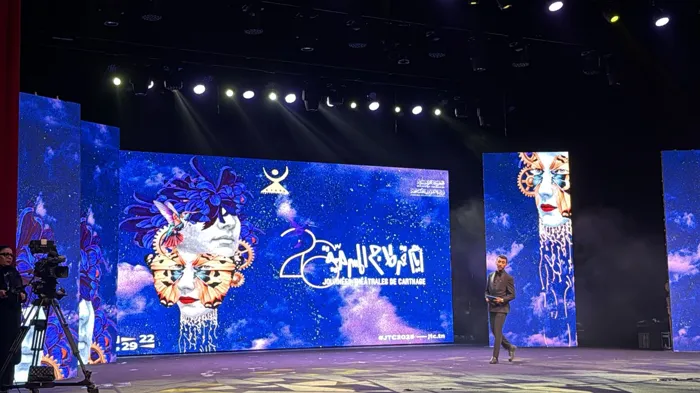
The 26th edition of the Carthage Theatre Days kicked off this Saturday evening at the City of Culture in Tunis, with a large attendance of artists, creators and intellectuals from inside and outside Tunisia.
Theater is awareness and change
In his opening remarks, the director of the session, Munir Al-Araqi, stressed that the current session is being held under the slogan “Theater is awareness and change… Theater is the pulse of the street,” noting that theater remains a space for expression, dreaming, and restoring man’s original energy.
He explained that the participating performances reflect voices and experiences from Tunisia, the Arab world, Africa and other countries, and raise visions and questions that intersect with contemporary human issues, stressing the importance of theater remaining active in confronting isolation and fear.
The Palestinian issue is present
Al-Araqi paused to reflect on the tragedy unfolding in the Gaza Strip, calling for the Palestinian cause to remain present in the human conscience, considering art to be an act of resistance, and that light itself can be a stance.
He noted that the program retains its core sections, while this year marks the launch of the International Theatre Forum for the first time, under the title “The Theatre Artist: His Time and Works,” providing a platform for dialogue on the artist’s relationship with his environment and the questions he faces. The program includes seven practical workshops led by specialists, in addition to a theatre research forum dedicated to doctoral dissertations at Tunisian universities, supporting the research movement.
Honored
The opening ceremony honored a distinguished group of Arab, African, and Tunisian theatrical figures, including Latifa Ahrar (Morocco), Imad Mohsen Ali Al Shanfari (Oman), and Abdel Rahman Kamati (Ivory Coast), as well as Tunisians Leila Rezgui and Fathi Akkari. Other Tunisian honorees included Ali Khmiri, Lazhari Sebaï, Salim Sanhaji, and Hadi Boumaiza.
A touch of loyalty
The opening ceremony also featured a touch of loyalty, as it celebrated a number of deceased Tunisian creators who left a clear mark on theater, cinema, television and criticism, including Ahmed Hazeq Al-Aref, Fathi Al-Haddawi, Mohamed Fadhel Al-Jaziri, Anwar Al-Shaafi, Faraj Shoushan, Abir Al-Jabali, Amara Al-Militi, Saleh Al-Bourjini, Mokhtar Mlih, Tawfiq Al-Hamami and Mohamed Ali Balhareth.
Musical show
The official opening was preceded by a musical performance on Habib Bourguiba Street entitled “Skins”, presented in an artistic format that reflects Tunisian, Arab and African identity, embodying Tunisia’s belonging to the Arab and African spaces.
King Lear
On opening night, the audience at the Opera House in the City of Culture watched the Egyptian production of “King Lear,” starring Yehia El-Fakharany, directed by Shady Sorour, and produced by the Egyptian National Theatre. Meanwhile, the Rio Cinema hosted the second opening performance, “(The) Dream… A Dark Comedy,” by the duo Jalila Baccar and Fadhel Jaibi.