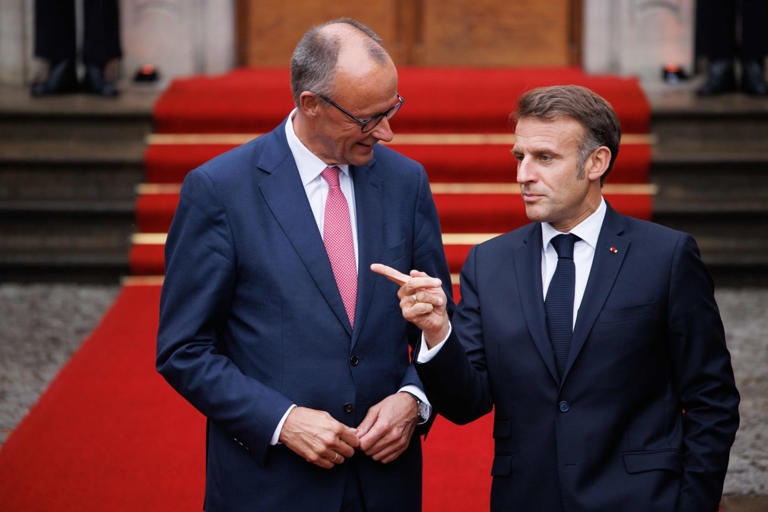
Germany does not plan to follow in France’s footsteps and recognize Palestine as a state in the near future, government spokesman Stefan Kornelius said on Friday.
He said the German government sees recognition as “one of the final steps” on the path to a two-state solution, which envisions an independent Palestinian state coexisting peacefully alongside Israel.
“The German government’s priority now is to achieve long overdue progress on the most urgent issues,” he said. These include a ceasefire in the Gaza war, the release of Israeli hostages by Hamas and the disarmament of the Palestinian Islamist group.
Kornelius again called on Israel to “immediately and drastically improve the catastrophic humanitarian situation in Gaza” and “provide the suffering civilian population with humane and urgently needed supplies.”
In addition, he said a viable political vision for Gaza is necessary so that a temporary ceasefire can ultimately bring lasting peace. Israel must also refrain from taking “any further steps towards annexing the West Bank,” he said.
The government spokesman said Germany is in constant contact with the Israeli government and its international partners on this issue and “is prepared to increase pressure if no progress is made.” He did not specify what measures this might involve.


The junior partner in Germany’s governing coalition, the centre-left Social Democrats, recently renewed calls to halt German arms exports to Israel and freeze the EU-Israel Association Agreement.
French President Emmanuel Macron announced on Thursday that France would recognize Palestine as a state in September.
Almost 150 UN member states already recognize Palestinian statehood. However, important Western countries are not among them, including the UN veto powers the United States and the United Kingdom.